
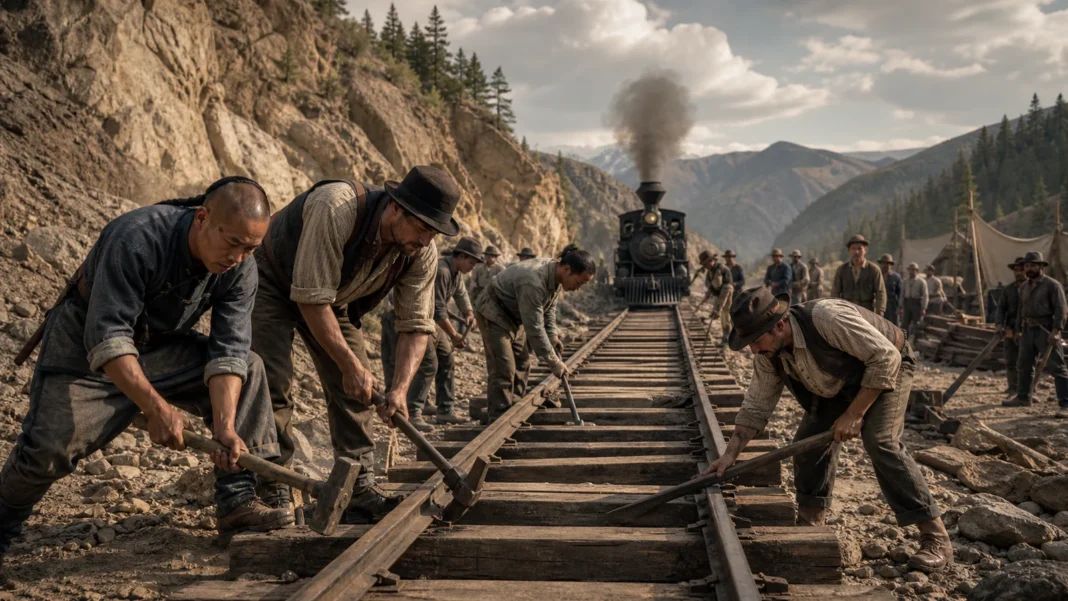

The quick answer: The first transcontinental railroad was completed at Promontory Summit, Utah Territory, on May 10, 1869. Union Pacific built west and Central Pacific built east, relying on thousands of workers—especially Chinese immigrants in the West—who faced dangerous conditions.
An engineering scale-up
Congress chartered the railroad companies during the Civil War. Crews graded roadbeds, bridged rivers, tunneled granite, crossed desert, laid ties and rails, and supplied moving work camps. Telegraph communication and industrial production helped coordinate a project spread across enormous distances.
The people behind the spike
Chinese workers became the majority of the Central Pacific labor force and served as laborers, foremen, contractors, cooks, interpreters, and skilled specialists. Irish immigrants, Civil War veterans, formerly enslaved people, Mormons, Native people, and other workers also built sections of the line. Their names were too often left outside the commemorative photograph.
Connection and disruption
Rail travel shortened journeys, expanded markets, standardized time, and helped create a continental economy. It also sped the destruction of bison herds, settlement of Tribal lands, military reach, environmental change, and exclusionary violence against Chinese communities. Infrastructure is never only technical; it rearranges power and place.
Put labor back in the landmark
The golden spike is an arresting symbol, but the deeper monument is the accumulated work of thousands. At 250, remembering the railroad well means naming the labor, recognizing both connection and cost, and asking how today’s national projects can distribute respect and benefit more fairly.
Quick facts
- The two rail lines met on May 10, 1869.
- Roughly 10,000 or more Chinese laborers worked on the Central Pacific.
- Chinese workers mounted a major strike in 1867 for better pay and conditions.
- Crews laid ten miles and fifty-six feet of track in one day near completion.
Questions readers ask
Why were Chinese workers essential?
They supplied the stable, highly skilled workforce that pushed the Central Pacific through the Sierra Nevada and across the desert under extreme conditions.
Did one railroad cross the entire continent?
No. Union Pacific and Central Pacific built toward each other and joined their lines at Promontory Summit.
Explore the sources
These primary and public-history resources are a good place to continue:
- National Park Service: Chinese Labor and the Iron Road
- National Park Service: Archaeology of Chinese Railroad Workers
250 Pulse tells the American story with context, confidence, and room for every neighbor.