
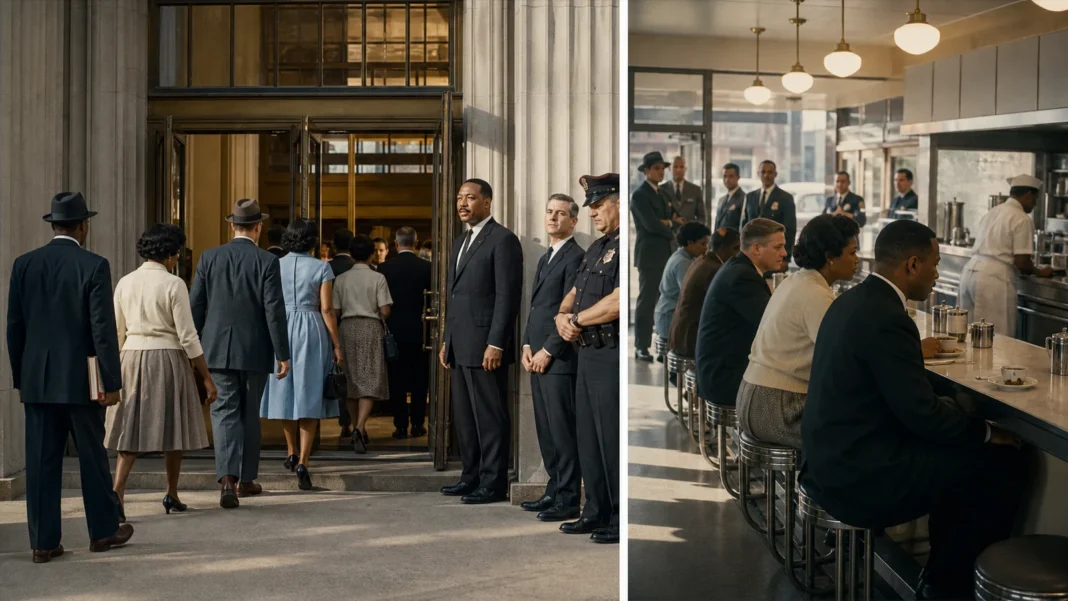

The quick answer: Signed on July 2, 1964, the Civil Rights Act prohibited segregation in public accommodations, addressed discrimination in education and federally assisted programs, and made employment discrimination illegal. It was a landmark victory produced by sustained citizen action and difficult legislative work.
The movement before the law
The act did not begin in a congressional chamber. Black Americans and allies organized boycotts, sit-ins, freedom rides, voter drives, lawsuits, marches, church networks, student groups, and local campaigns. They endured violence and arrest while making the distance between American ideals and daily reality impossible to ignore.
A long legislative fight
President John F. Kennedy proposed major civil rights legislation in 1963, and President Lyndon Johnson pressed for passage after Kennedy’s assassination. In the Senate, a bipartisan coalition overcame an extended filibuster. The 71-29 cloture vote on June 10 cleared the way for final passage.
What the act changed
The law attacked discrimination across public accommodations, federally funded programs, education, and employment. Title VII created a federal framework for challenging workplace discrimination. Statutory language did not end prejudice, but it gave individuals, communities, agencies, and courts stronger tools to confront it.
Democracy can correct itself
The act is a patriotic story precisely because it began with criticism. Citizens demanded that the nation take its own commitments seriously, and institutions eventually responded. At America’s 250th, the lesson is hopeful and practical: progress needs conscience, organization, coalition, law, enforcement, and the willingness to continue after a victory.
Quick facts
- President Lyndon Johnson signed the act on July 2, 1964.
- The Senate voted 71-29 for cloture to end the filibuster.
- The law addressed public accommodations, schools, federally funded programs, and employment.
- Title VII prohibited specified forms of employment discrimination.
Questions readers ask
Did the Civil Rights Act end discrimination?
No. It created powerful national protections and enforcement tools, while implementation and later civil-rights work remained necessary.
Was passage the work of one party or leader?
No. It required years of movement leadership and a broad, bipartisan congressional coalition, along with executive advocacy.
Explore the sources
These primary and public-history resources are a good place to continue:
- National Archives: Civil Rights Act of 1964
- U.S. Senate: Landmark Legislation – Civil Rights Act of 1964
250 Pulse tells the American story with context, confidence, and room for every neighbor.