
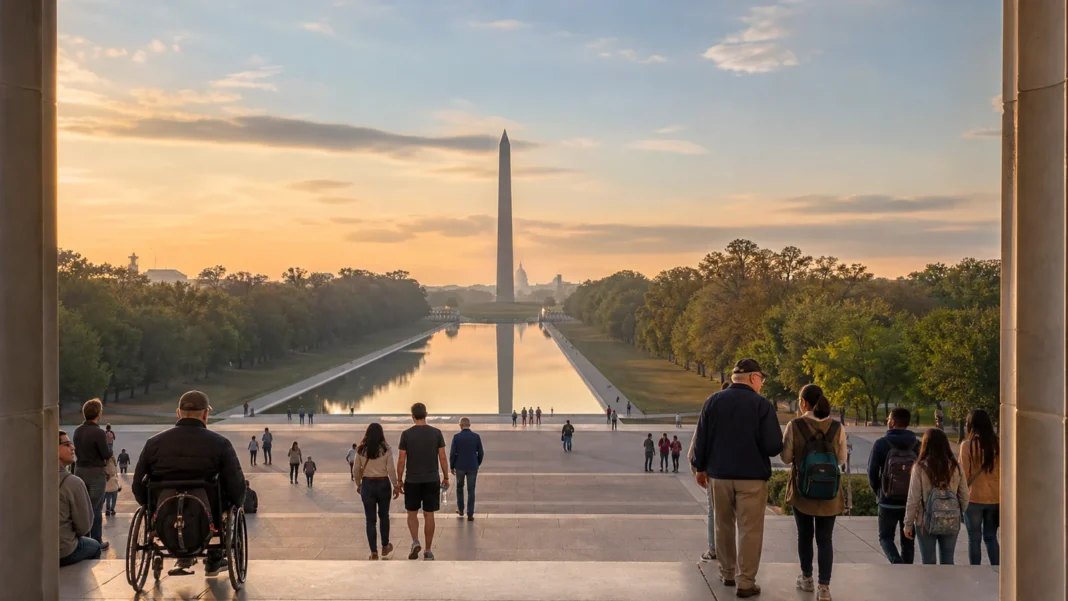

The quick answer: The National Mall is the monumental civic landscape at the center of Washington, D.C. Planned across generations, it connects institutions, memorials, museums, public recreation, national ceremonies, and First Amendment assembly.
A capital planned in vistas
Pierre Charles L’Enfant’s 1791 plan imagined a grand public avenue linking the Capitol with the river. The landscape developed unevenly for a century. The McMillan Plan of 1901–1902 restored a formal east-west axis, and work in the 1930s produced much of the open lawn and tree-lined form familiar today.
Stone memory, living public
Memorials invite reflection on presidents, wars, service members, civil rights, and national ideals. Smithsonian museums place art, science, culture, and history beside that commemorative landscape. Yet the Mall is also grass, paths, games, school trips, cherry-blossom walks, and ordinary days.
The stage for speaking to America
Marches, demonstrations, vigils, inaugurations, festivals, and celebrations transform the same space. The March on Washington, antiwar gatherings, AIDS Memorial Quilt, and countless causes have used the Mall’s symbolic geography to make a public claim: this concern belongs in the national story.
An open space with shared meaning
Caring for the Mall requires preservation, accessibility, safety, event management, landscape work, and room for lawful disagreement. At 250, its power comes from the combination. It is a formal national symbol that remains open enough for the people to gather, celebrate, criticize, mourn, and imagine.
Quick facts
- L’Enfant included a grand avenue in his 1791 plan.
- The McMillan Plan reshaped the monumental core in the early twentieth century.
- The broader National Mall includes major memorial landscapes west of the Washington Monument.
- The area serves recreation, ceremonies, protests, festivals, museums, and remembrance.
Questions readers ask
Is the Mall only the lawn between the Capitol and Washington Monument?
Historically, that is the Mall proper; common usage and National Park Service administration include a broader memorial landscape extending westward.
Why are demonstrations held there?
Its openness, visibility, proximity to government, and national symbolism make it a powerful place for protected speech and assembly.
Explore the sources
These primary and public-history resources are a good place to continue:
250 Pulse tells the American story with context, confidence, and room for every neighbor.