
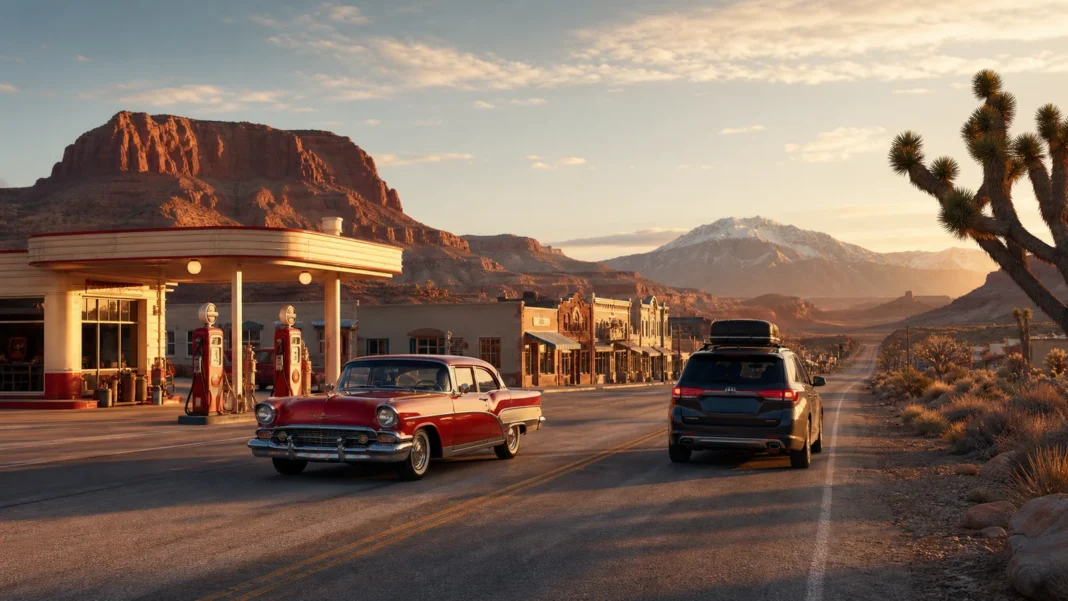

The quick answer: Established in 1926, U.S. Route 66 linked Chicago and Los Angeles across roughly 2,400 miles. It became an icon of automobile mobility and roadside enterprise before being removed from the federal highway system in 1985.
A highway assembled from roads
Route 66 joined existing roads into a major corridor across eight states. It was promoted as a relatively direct, all-weather connection between the industrial Midwest and the Pacific Coast. Federal designation, local improvements, signs, maps, and business advocacy gave the route a national identity.
Migration and Main Street
Dust Bowl families traveled west seeking work, wartime traffic moved people and materiel, and postwar families embraced auto tourism. Gas stations, repair shops, motor courts, cafes, curio stores, and neon signs created a roadside economy that offered small towns direct contact with national movement.
Freedom was not equally available
Black travelers faced segregation, refusal of service, and danger, relying on trusted guides and community knowledge. Native communities along the route experienced tourism, commerce, appropriation, and changing access to their own lands. A full road story includes the travelers whose mobility required extra planning and courage.
Preserving more than pavement
Interstates bypassed towns and replaced the old federal route, but local groups preserved signs, buildings, alignments, and stories. At 250, Route 66 remains a vivid way to explore what movement does: it connects opportunity, transforms landscapes, creates myths, and leaves some places searching for a new road forward.
Quick facts
- Route 66 was designated in 1926.
- It ran from Chicago to Los Angeles through eight states.
- Its historic route covered roughly 2,400 miles.
- The highway was removed from the U.S. Highway System in 1985.
Questions readers ask
Can you still drive all of Route 66?
Many historic alignments survive, but the route is no longer one continuous federal highway. Conditions and signage vary by state and community.
Why is it called the Mother Road?
John Steinbeck used that phrase in The Grapes of Wrath, helping attach it to the route’s migration story.
Explore the sources
These primary and public-history resources are a good place to continue:
250 Pulse tells the American story with context, confidence, and room for every neighbor.