
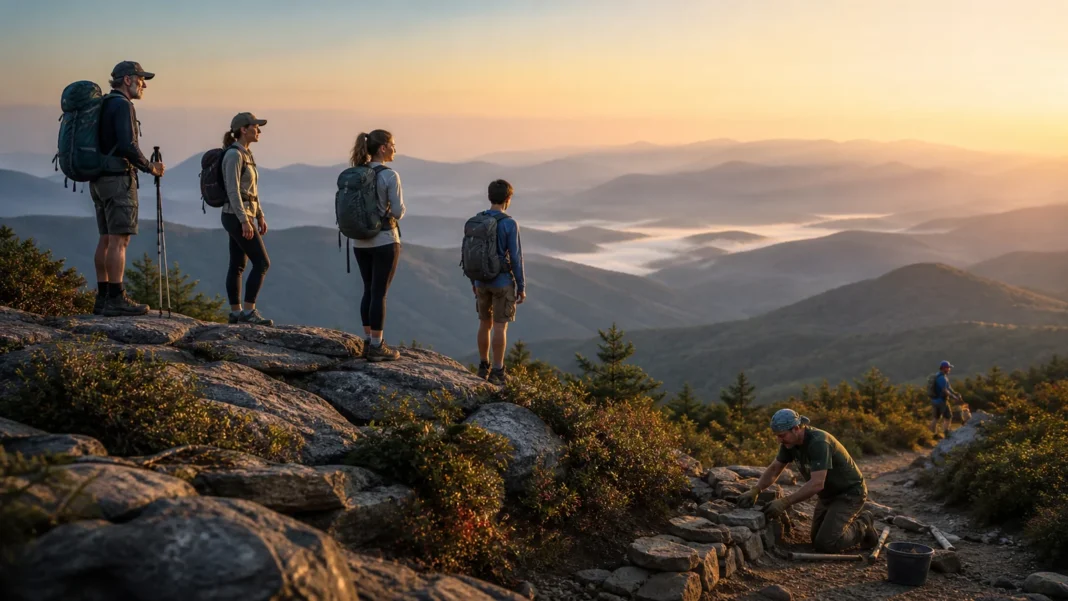

The quick answer: The Appalachian National Scenic Trail follows the Appalachian Mountains through fourteen states. Conceived by Benton MacKaye in 1921, it is cooperatively managed by public agencies, the Appalachian Trail Conservancy, local clubs, and thousands of volunteers.
A vision longer than one person
MacKaye imagined a connected landscape where people could regain contact with nature. Volunteers and trail clubs translated the concept into surveyed routes, cleared footpath, shelters, signs, and agreements. The original trail was completed in the 1930s, though its location has continued to evolve.
Fourteen states, one footpath
The A.T. runs from Springer Mountain in Georgia to Katahdin in Maine through forests, farms, ridgelines, parks, towns, and culturally significant landscapes. Its length shifts with relocations, which protect resources, improve experience, and respond to changing land conditions.
Cooperative management in boots
No single organization maintains the trail alone. The National Park Service, U.S. Forest Service, states, the Appalachian Trail Conservancy, and dozens of clubs share responsibility. Volunteers cut brush, build drainage, monitor species, repair structures, protect boundaries, and welcome hikers.
The walk depends on stewardship
A continuous path can feel wild and effortless, but that experience is carefully sustained. Crowding, erosion, invasive species, extreme weather, development, and climate change demand active care. At 250, the A.T. is an encouraging model: public land and citizen stewardship can form one durable national project.
Quick facts
- The trail passes through fourteen states.
- Benton MacKaye proposed the concept in 1921.
- Congress designated it a National Scenic Trail in 1968.
- Thirty-one trail clubs have traditionally coordinated much of the volunteer maintenance.
Questions readers ask
How long is the Appalachian Trail?
The exact mileage changes as sections are relocated; it extends well over 2,000 miles from Georgia to Maine.
Do only thru-hikers use it?
No. Most visitors take day hikes or shorter trips, and many communities use nearby sections as local recreation space.
Explore the sources
These primary and public-history resources are a good place to continue:
- National Park Service: Appalachian National Scenic Trail
- National Park Service: Partnering to Protect the Appalachian Trail
250 Pulse tells the American story with context, confidence, and room for every neighbor.