
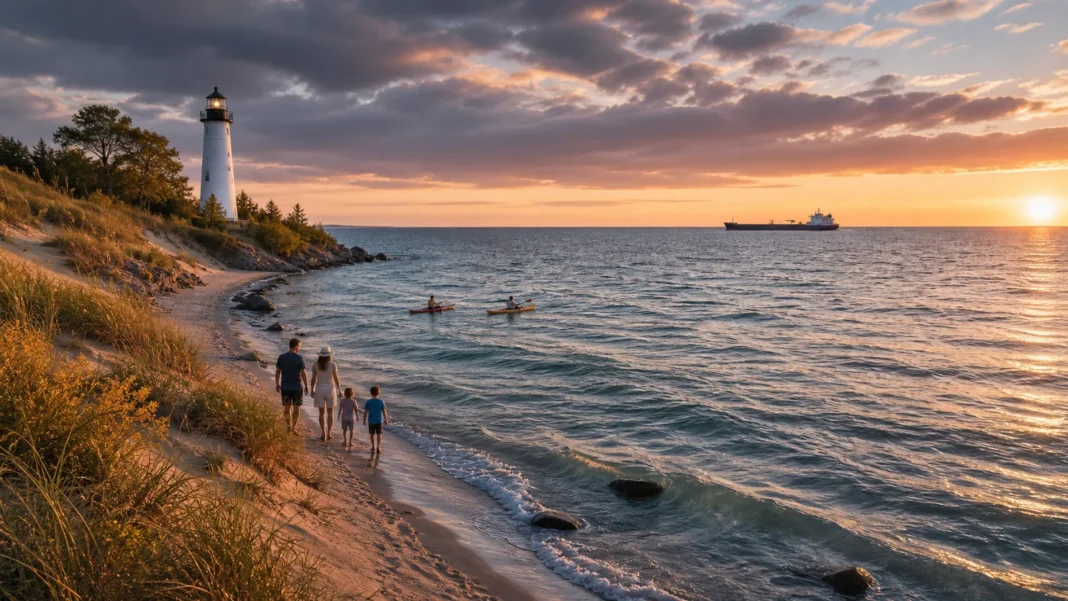

The quick answer: Lakes Superior, Michigan, Huron, Erie, and Ontario form one of the world’s largest surface-freshwater systems. Shared by the United States and Canada, they support drinking water, shipping, industry, fisheries, power, recreation, and rich ecosystems.
Freshwater on an inland scale
The lakes stretch more than 750 miles from west to east and contain about 84 percent of North America’s surface fresh water. Their size creates ocean-like weather, waves, horizons, ports, and maritime culture. Yet only a small share of their water is renewed each year, making contamination slow to reverse.
A corridor of work and culture
Anishinaabe and other Indigenous nations have lived with and governed these waters for generations. Later canals and shipping connected iron ore, grain, coal, manufacturing, and global trade. Fishing, shipbuilding, lighthouses, beaches, cities, and music created distinctive regional identities around the shore.
Damage crosses boundaries
Industrial pollution, sewage, habitat loss, invasive species, agricultural runoff, and toxic contamination do not respect state or national lines. Major cleanup and restoration efforts have improved conditions, but algal blooms, shoreline pressure, warming water, and legacy pollutants remain.
Cooperation is the only scale that fits
One lake connects to the next, and every tributary carries upstream choices. Protection therefore depends on Tribal, local, state, provincial, federal, and binational work. At 250, the lakes are both inheritance and instruction: abundance is not permission to waste; it is responsibility enlarged by scale.
Quick facts
- The Great Lakes are Superior, Michigan, Huron, Erie, and Ontario.
- They contain about 84 percent of North America’s surface fresh water.
- The basin spans parts of the United States and Canada.
- The lakes support drinking water, transportation, power, industry, recreation, and ecosystems.
Questions readers ask
Are the Great Lakes freshwater seas?
They are lakes, but their enormous size, waves, weather, shipping, and maritime culture make inland seas an apt description.
Why does cleanup require two countries?
The connected waters and shared watershed cross the international boundary, so pollution and habitat decisions on one side affect the other.
Explore the sources
These primary and public-history resources are a good place to continue:
- U.S. Environmental Protection Agency: Great Lakes Facts and Figures
- NOAA Great Lakes Environmental Research Laboratory
250 Pulse tells the American story with context, confidence, and room for every neighbor.