
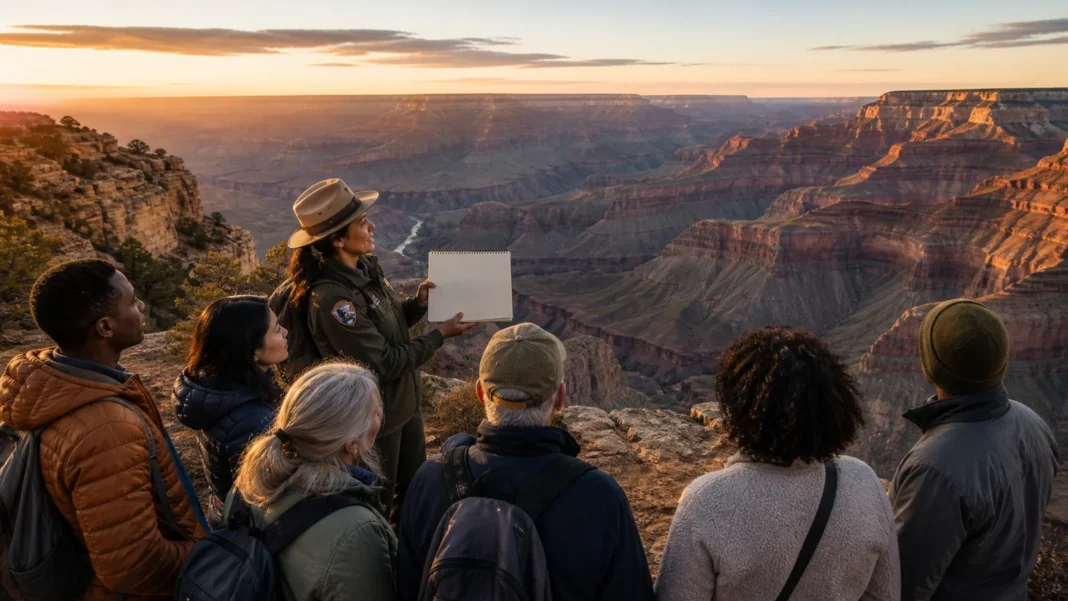

The quick answer: The Grand Canyon exposes a vast sequence of rock layers in the Colorado Plateau. Some basement rocks are nearly two billion years old, while the modern canyon was carved largely during the past five to six million years by the Colorado River and erosion.
Read the walls from bottom to top
The dark rocks of the inner gorge formed nearly two billion years ago. Above them, younger sedimentary layers record seas, shores, deserts, rivers, and living communities across immense spans of time. In general, lower layers are older than those resting above them.
Uplift, river, erosion
Tectonic forces raised the Colorado Plateau while preserving broad, relatively level strata. The Colorado River then cut downward as the regional drainage system developed. Tributaries, rain, ice, heat, rockfall, and gravity widened and sculpted the canyon. Formation is an ongoing process, not one ancient event.
A human homeland, not an empty wonder
The canyon is culturally significant to eleven traditionally associated Tribal nations. Indigenous histories, place names, routes, farming, ceremony, and living relationships extend far beyond the park’s creation. Scientific wonder and cultural respect belong in the same view.
A national park with planetary scale
The canyon can make one human lifetime feel brief without making human choices unimportant. Water management, visitation, mining proposals, climate change, and habitat protection affect what future generations inherit. At 250, its deepest patriotic lesson may be humility: some national treasures ask us to think in centuries.
Quick facts
- The oldest exposed basement rocks are about 1.84 billion years old.
- The youngest major South Rim layer is roughly 270 million years old.
- The modern canyon was carved mainly during the past five to six million years.
- Eleven Tribal nations are traditionally associated with Grand Canyon.
Questions readers ask
Did the Colorado River create all the rock layers?
No. The layers formed long before the canyon; the river and erosion later cut through and exposed them.
Is every part of Grand Canyon the same age?
No. Rocks, deposits, river segments, and landscape features formed at different times, and scientists continue to refine the history.
Explore the sources
These primary and public-history resources are a good place to continue:
250 Pulse tells the American story with context, confidence, and room for every neighbor.