
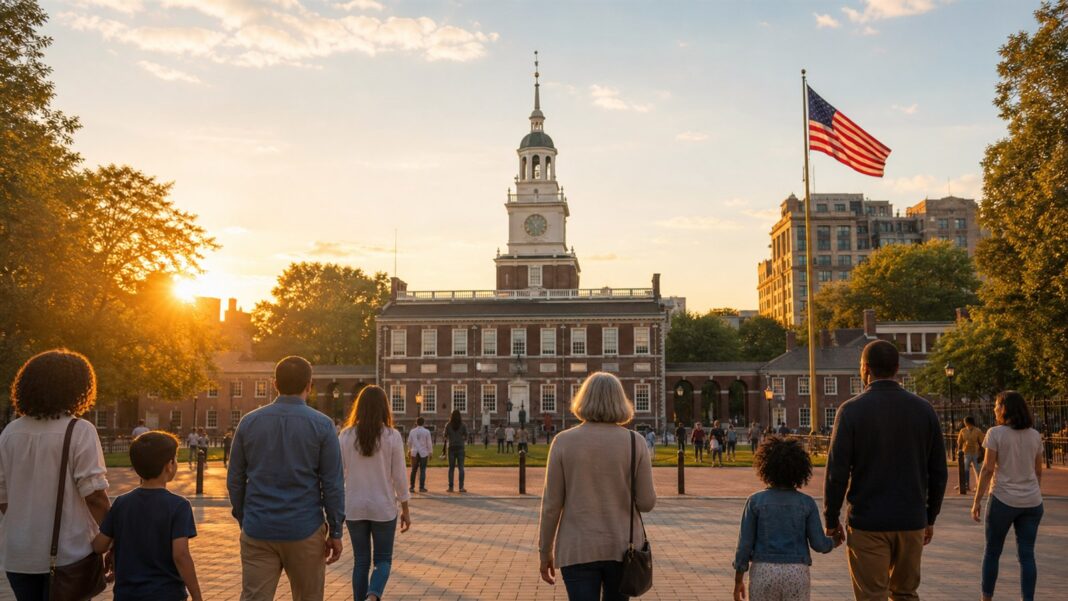

On the United States’ 250th anniversary, the most patriotic thing we can do is remember what Americans inherited, honor what generations built, and accept responsibility for what comes next.
Two hundred and fifty years is long enough for a country to gather legends, arguments, triumphs, scars, traditions, and millions of family stories. It is also short enough to remember that the American experiment is still young. The anniversary of July 4, 1776, is therefore more than a giant birthday. It is a chance to look at the nation with gratitude and clear eyes: to celebrate a republic that has endured, to recognize the people who widened its promise, and to ask what kind of inheritance today’s Americans will leave behind.
The quick answer
America’s 250th anniversary is July 4, 2026. It commemorates 250 years since the Continental Congress adopted the Declaration of Independence. The milestone is an opportunity to celebrate the country’s endurance and achievements, honor the many people who shaped it, and renew the civic work required to carry its founding ideals forward.
More than a birthday
The country’s semiquincentennial marks 250 years since the Continental Congress adopted the Declaration of Independence on July 4, 1776. The official America250 initiative describes the commemoration as an opportunity for Americans to reflect on the past, honor the contributions of Americans, and imagine the future they want to create. That balance matters. A meaningful anniversary should contain fireworks and family cookouts, but it should also contain memory, curiosity, and purpose.
America’s story did not unfold in a straight line from declaration to destiny. It moved through risk, disagreement, sacrifice, reinvention, and the persistent work of citizens. The nation survived a civil war, expanded constitutional rights, welcomed generations of newcomers, built institutions with global influence, and repeatedly confronted the distance between its ideals and its reality. The fact that the work remains unfinished does not make the anniversary less worthy of celebration. It explains why the anniversary matters.
The promise at the center
The Declaration announced separation from Great Britain, but its enduring power comes from the principles used to justify that decision. It placed equality, rights, consent, and human dignity at the center of the American argument. The National Archives notes that the Declaration is not itself a binding law; its force is moral and political. It states the principles on which the nation understands its government and its identity.
Those principles were broader than the political reality of 1776. Their reach had to be fought for, interpreted, and extended by later generations. Abolitionists read the founding promise and demanded that it apply to enslaved people. Suffragists claimed it for women. Civil-rights leaders measured the country against its own words. Immigrants arrived believing that citizenship could be joined rather than inherited. Service members defended a constitutional system designed to outlast any single leader.
American pride is strongest when it has both roots and direction.
This is one of the most distinctive features of the American tradition: its founding language became a standard that Americans could use to challenge America. The promise was never self-executing. Yet because it was written down, argued over, and placed in public view, it gave citizens a vocabulary for reform.
A nation built by many hands
A country is more than its famous leaders. It is also the daily achievement of people whose names rarely enter textbooks: farmers who improved the soil, machinists who mastered a difficult tolerance, teachers who opened a child’s world, nurses who stayed through the night, entrepreneurs who risked their savings, volunteers who arrived after storms, parents who built a new life in an unfamiliar language, and neighbors who kept local institutions alive.
The United States grew powerful because it learned—imperfectly, sometimes painfully—to draw ability from a huge range of people and places. Its culture was shaped by Indigenous peoples and by settlers, by descendants of the enslaved and by newcomers from every continent, by rural communities and great cities, by faith and dissent, by old customs and restless invention. Unity did not require sameness. The national motto E pluribus unum captured a harder and more ambitious idea: out of many, one.
That “one” is not a demand to erase local identity. A Texan can love Texas, a member of the Cherokee Nation can honor a sovereign heritage, a new citizen can keep the language of childhood, and a New Yorker can remain unmistakably New York. The American identity is capacious enough to hold those loyalties together when citizenship supplies a common civic home.
Patriotism as stewardship
Patriotism is often pictured as a flag on a porch, a hand over the heart, or a crowd rising for the national anthem. Those gestures can be sincere and moving. But the durable form of patriotism is stewardship: caring for something precious that we did not create alone and cannot keep for ourselves.
Stewardship turns affection into practice. It means learning enough history to resist both cynicism and mythology. It means voting, serving on a jury, respecting a neighbor’s equal rights, keeping public spaces usable, helping a local organization, and leaving institutions stronger than we found them. It also means disagreeing without treating fellow citizens as enemies. In a self-governing republic, the quality of national life eventually reflects the habits of ordinary people.
This version of patriotism does not need someone else to despise. It is confident enough to admire what is good, honest enough to repair what is weak, and generous enough to invite participation. It asks not whether America has been perfect, but whether Americans are willing to keep faith with the best of its promise.
Five ways to mark 250
- Read one founding document. Start with the Declaration, Constitution, or Bill of Rights in the National Archives’ plain, searchable presentation. Read slowly enough to notice both the familiar lines and the difficult questions.
- Learn one local story. Every county has a place, person, craft, migration, enterprise, or act of service that belongs in the larger American story. Visit a historical society, museum, tribal cultural center, battlefield, archive, or landmark.
- Thank someone who serves. Recognition is not limited to military service. Consider teachers, first responders, election workers, caregivers, park staff, librarians, coaches, and volunteers.
- Make something that lasts. Plant a tree, record a grandparent’s memories, restore a neighborhood feature, mentor a young person, or contribute skilled work to a community project.
- Write a note to 2276. What do you hope Americans celebrating the 500th anniversary will say our generation protected, repaired, or began?
What the next 250 asks of us
The next American chapter will be shaped by questions the founding generation could not imagine: artificial intelligence, biotechnology, space exploration, new energy systems, and a world connected at near-instant speed. But the essential challenge remains familiar. Can free people govern themselves with courage, restraint, fairness, and imagination?
The answer will not arrive from Washington alone. It will be written in homes, schools, workshops, laboratories, houses of worship, city halls, military units, small businesses, and neighborhood meetings. It will depend on whether Americans can recover the civic confidence to solve problems together while protecting the freedom to differ.
At 250, the United States has earned celebration—not because its history is flawless, but because generation after generation has found reasons to preserve, improve, and pass on the experiment. The flag is not only a symbol of what the country has been. In our hands, it is a promise about what the country can still become.
Quick facts about America’s 250th
What does “semiquincentennial” mean?
It means a 250th anniversary. The United States’ semiquincentennial commemorates 250 years since the adoption of the Declaration of Independence.
When is America’s 250th anniversary?
The anniversary is July 4, 2026. Related commemorations and programs began before that date and continue at national, state, territorial, and local levels.
Is 250 Pulse the official America250 website?
No. 250 Pulse is an independent editorial project inspired by the 250th anniversary. The official nonpartisan national initiative is America250.