
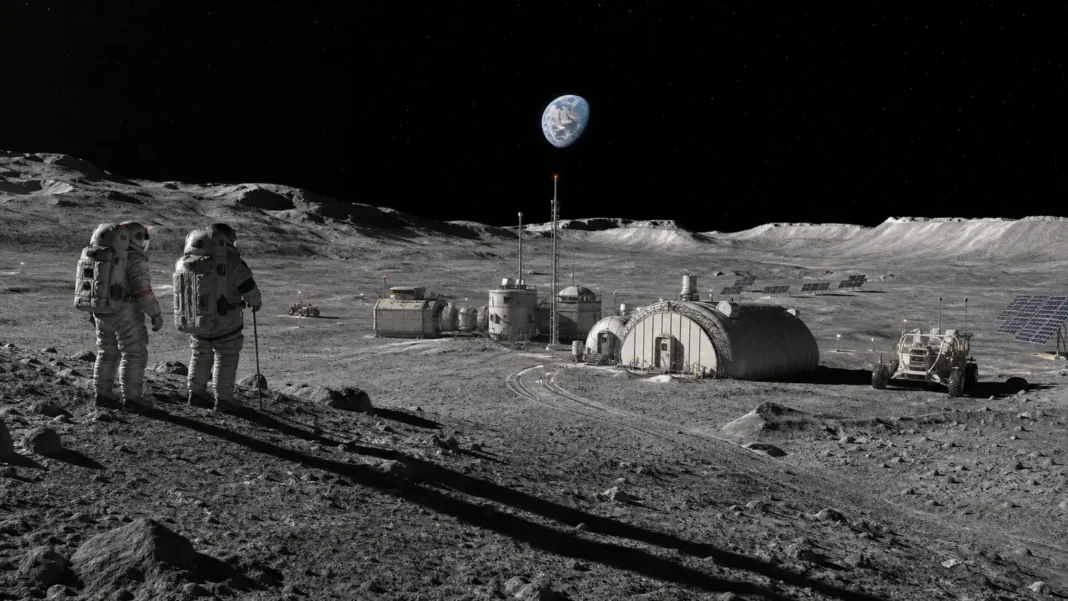

Apollo proved Americans could reach the Moon. The next chapter asks a harder question: can we learn to work there, return regularly, and build knowledge that carries humanity farther?
More than half a century after Apollo 17 left the lunar surface, the Moon is again becoming a destination for American science, engineering, and enterprise. The goal is not to recreate 1969 with newer equipment. NASA’s Moon to Mars strategy treats the Moon as a place for sustained exploration, research, technology testing, international cooperation, and preparation for human missions to Mars.
That makes the return less like a single expedition and more like the beginning of infrastructure. Landers, power, communications, navigation, habitats, suits, rovers, science instruments, cargo services, and reliable supply chains must work together in one of the harshest environments humans have attempted to enter. At America’s 250th anniversary, the effort revives an old national strength: turning an ambitious frontier into thousands of exacting jobs.
The quick answer
America is going back to the Moon to conduct science, develop technologies for long-duration exploration, expand commercial space capabilities, and prepare for future human missions to Mars. NASA’s evolving Moon to Mars architecture emphasizes objectives rather than one symbolic landing. The lunar south polar region is especially valuable because permanently shadowed areas may preserve water ice and nearby high points can offer useful sunlight and communications conditions.
In this article
- This is not Apollo again
- Why the lunar south pole matters
- A testbed for hard technology
- A commercial frontier, carefully built
- The road to Mars runs through experience
- What success should look like
This is not Apollo again
Apollo was a breathtaking national achievement shaped by the Cold War. Its central objective was clear: land astronauts on the Moon and return them safely to Earth before the decade ended. At its peak, the program drew on hundreds of thousands of workers and an industrial network spread across the country.
The current effort has a different design. NASA describes an evolving architecture built around sustained lunar use, scientific discovery, commercial participation, and preparation for Mars. Instead of one giant machine owned end to end by the government, the program increasingly combines NASA systems with services, landers, spacecraft, instruments, and technologies developed by private companies and international partners.
That approach can lower some costs and create wider capability, but it also raises the difficulty of integration. Hardware made by different organizations must communicate, dock, exchange power and data, meet safety requirements, and arrive on schedules that depend on one another. The frontier is no longer only distance. It is coordination.
Why the lunar south pole matters
The Moon’s south polar region contains permanently shadowed craters that are among the coldest known places in the solar system. Scientific observations indicate that water ice may be present in some of these areas. Water is valuable for research, human life support, and potentially for producing oxygen or rocket propellant if extraction proves practical.
The terrain is difficult. Sunlight arrives at low angles, throwing long shadows across craters and ridges. Temperatures vary sharply. Communications can be obstructed. Dust is abrasive and electrostatically troublesome. Landing near useful resources without placing a vehicle in darkness or on unsafe ground requires precise navigation.
That difficulty is part of the reason to go. A sustained presence must learn how to map resources, store energy, operate through darkness, manage dust, maintain equipment, and protect crews from radiation. Each solved problem becomes knowledge for other destinations.
A testbed for hard technology
The lunar surface does not forgive vague promises. A power system either produces energy through extreme conditions or it does not. A suit either protects mobility and life or it fails. A landing pad either limits dangerous ejecta or every nearby asset pays the price.
NASA’s lunar surface technology work includes power generation and storage, resource prospecting and use, construction with local material, dust mitigation, autonomous robotics, navigation, communications, and systems for moving cargo. These technologies must be tested on Earth, in simulations, in orbit, and eventually on the Moon itself.
Work at the Moon can also improve systems used on Earth. Extreme efficiency, reliable remote operation, lightweight materials, closed-loop life support, energy storage, medical monitoring, and autonomous maintenance have applications far beyond space. Not every project will produce a household spinoff, nor should that be the sole test. The broader value lies in forcing tools and teams to perform where replacement parts are days away and rescue is never simple.
A frontier becomes useful when ambition is converted into standards, hardware, repeatable procedures, and people who know how to make them work together.
A commercial frontier, carefully built
NASA is using commercial contracts to deliver scientific and technology payloads to the Moon and to develop parts of the exploration system. The strategy aims to create customers, competition, and experience beyond a single government mission. Companies can improve vehicles across repeated flights and eventually serve markets that do not depend entirely on NASA.
A genuine lunar economy remains uncertain. Transportation is expensive, demand is young, and technical risk is high. Responsible optimism should distinguish a durable service from a presentation rendering. It should also insist on clear rules for safety, resource activity, scientific protection, debris, and cooperation.
Government has often helped establish infrastructure before a private market was obvious: surveys, ports, aviation standards, weather data, communications research, and early procurement. The lunar case follows that tradition. Public investment can open a difficult domain while competition improves methods—but only if the work produces real capacity rather than a cycle of announcements.
The road to Mars runs through experience
Mars is far more difficult than the Moon. Depending on the positions of the planets, communication takes minutes each way. Crews cannot depend on real-time direction from Earth. A journey requires long-duration life support, radiation protection, maintenance, medical independence, surface power, and the ability to make decisions without quick rescue.
The Moon is not a perfect copy of Mars, but it is a nearby place to learn expeditionary discipline. Teams can practice living away from Earth, operating surface systems, managing limited supplies, using local resources, and coordinating robots with humans. Failures will still be dangerous, yet lessons can be applied sooner than after a multi-year Mars campaign.
NASA’s objectives-based approach is useful here. The “why” should guide the hardware. Missions should answer questions, retire risks, and build capabilities that connect to a longer path. Planting another flag without accumulating durable knowledge would be nostalgia, not exploration.
What success should look like
Launches and landings will receive the attention, but the strongest evidence of success will be less cinematic. Hardware survives longer than designed. A second crew uses what the first crew left. Cargo arrives on a predictable schedule. Scientific data is shared. Different systems connect without improvisation. Costs fall because experience accumulates.
- More than a destination. Each mission should build capability that the next mission can use.
- More than one supplier. Competition and common standards make the system more resilient.
- More than symbolism. Science, engineering, and economic claims should be measurable.
- More than a federal enclave. Students, small firms, universities, skilled trades, and regions across the country should be able to contribute.
- More than one administration. A durable architecture must survive political change through clear value and honest progress.
The return to the Moon is not important because Americans need an enemy to beat. It matters because free societies need difficult, peaceful projects that reward competence and widen imagination. The work links welders and physicists, machinists and doctors, software teams and test crews, public institutions and private risk.
At 250, the United States can look back at footprints on the Moon without treating the past as the limit of national possibility. Apollo remains proof of courage. The next 250 will require something equally American and more patient: the courage to build, learn, return, and leave a working path for those who come after.
Quick facts about America’s return to the Moon
Why is NASA returning to the Moon?
NASA plans to use lunar missions for science, technology development, sustained exploration, commercial and international cooperation, and preparation for future human missions to Mars.
Why explore the Moon’s south pole?
The south polar region contains permanently shadowed areas that may hold water ice and terrain with potentially useful lighting conditions. It also presents important scientific and engineering challenges.
What is the Moon to Mars architecture?
It is NASA’s evolving framework for connecting exploration objectives, missions, systems, and technologies from the Moon to eventual human exploration of Mars.
Will private companies go to the Moon?
Private companies already build spacecraft and provide lunar delivery services under NASA contracts. NASA’s strategy seeks to expand commercial capability, though a self-sustaining lunar market is still developing.