
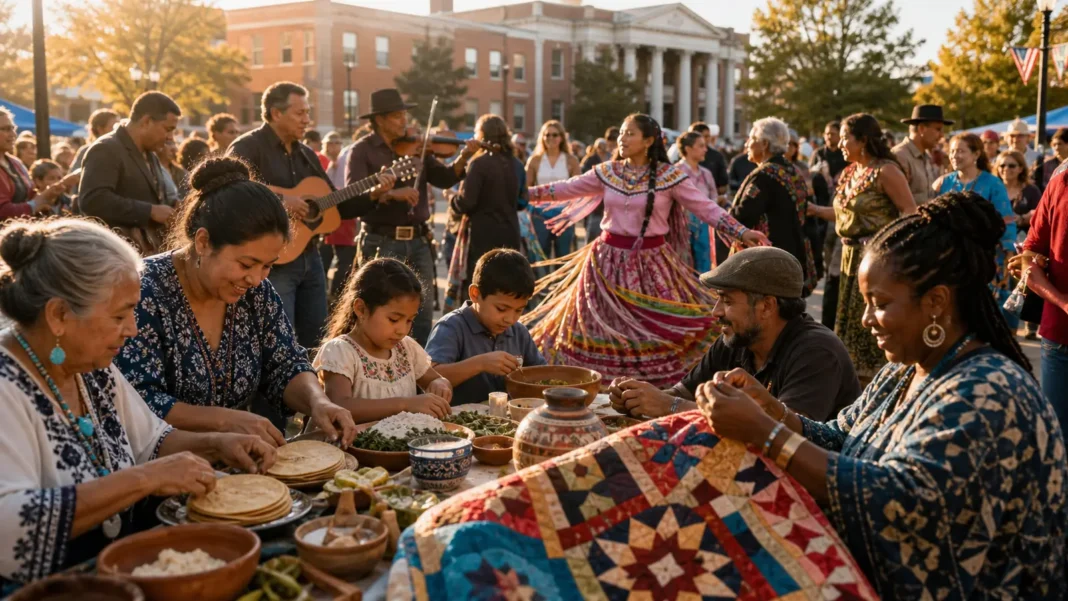

American culture is not a finished object in a museum case. It is a recipe adjusted by memory, a rhythm crossing a city block, a tool held the way a grandparent taught, and a holiday made local.
The United States is often described as a melting pot. The phrase captures mixture, but not everything mixture can mean. Some traditions blend. Others remain distinct. Many do both: a family keeps a language for intimate moments, adds a regional ingredient to an old dish, joins a town parade, and teaches children songs that now belong to two places at once.
This is not cultural confusion. It is one of America’s oldest creative habits. People arrive, move, marry, work, worship, improvise, borrow, protect, and pass things on. At the nation’s 250th anniversary, the living traditions of families and communities offer a warmer definition of unity: not sameness, but a common home spacious enough for memory.
The quick answer
American living traditions are the customs, skills, stories, foods, music, crafts, celebrations, and everyday practices that communities learn and pass on. The Library of Congress uses “folklife” for this shared expressive culture across familial, ethnic, occupational, religious, and regional groups. American culture grows when traditions are preserved with integrity and exchanged with curiosity and respect.
In this article
- Culture is a verb
- The table as an archive
- The sound of many roots
- Traditions travel—and take root
- Unity without sameness
- How to keep a tradition alive
Culture is a verb
Culture can sound like a shelf of masterpieces: novels, paintings, concert music, architecture. Those achievements matter. Folklife directs attention to what people do together—often without calling it art and without formal instruction.
It includes the boatbuilder’s eye for a curve, the call-and-response learned in church, the hand signals of workers around loud machinery, the pattern of a quilt, the route of a holiday procession, the slang of a profession, and the family story that changes slightly with every teller. Children learn these things by watching, listening, repeating, and eventually adding their own style.
Congress created the American Folklife Center at the Library of Congress in 1976, the bicentennial year. That timing was fitting. The country celebrated two hundred years not only by looking at famous documents, but by recognizing that the people themselves carry archives in memory, movement, sound, and skill.
A tradition stays alive not because nobody changes it, but because somebody cares enough to practice it again.
The table as an archive
Foodways are more than recipes. The Library of Congress uses the term for the practices around growing, sourcing, preparing, serving, and sharing food—and for the relationships between food, ceremony, storytelling, work, environment, and migration.
An American table can hold Indigenous crops, African techniques, European preservation methods, Asian seasonings, Latin American staples, and an adaptation invented because one ingredient was available at the local store. Regional dishes record climate and labor. Barbecue traditions reveal wood, livestock, migration, and community competition. Seafood stews tell coastal histories. Church suppers and block parties turn food into association.
The dish changes, but change does not erase origin. A respectful food culture asks where ingredients and techniques came from, who carried them, and how unequal histories shaped what became popular. Credit makes enjoyment richer. It lets a meal become an invitation to know the people behind it.
The sound of many roots
American music offers the clearest example of traditions meeting without becoming anonymous. African American spirituals, blues, gospel, and rhythmic innovation transformed the nation and the world. European ballads changed in the Appalachians. Indigenous songs continue within sovereign traditions. Jazz, country, zydeco, conjunto, bluegrass, hip-hop, Hawaiian music, and countless local forms grew from particular communities while crossing every boundary available.
The American Folklife Center holds music and dance materials representing virtually every diasporic community in every state and territory. An archive of that size does not reveal one national sound. It reveals a national pattern: people keep roots, encounter neighbors, and create forms that neither group would have made alone.
That pattern continues on front porches, in school gyms, at powwows, dance halls, houses of worship, clubs, festivals, and bedrooms where teenagers learn from recordings made before their grandparents were born. Technology changes transmission. The human need to make rhythm social remains.
Traditions travel—and take root
Migration carries more than people and possessions. It carries ways of greeting, grieving, celebrating, seasoning, naming, repairing, singing, arranging a room, and honoring the dead. In a new place, those practices meet different weather, materials, schedules, laws, and neighbors.
A tradition may become more deliberate after migration. Something once ordinary becomes a marker of continuity. A language school opens on weekends. A religious festival moves into a public park. A grandmother writes down a recipe she always made by feel. An occupational skill finds a new market. Children who once wanted to hide a custom later return with questions.
Americanization, in this view, is not the deletion of memory. It is participation in a common civic life while contributing knowledge from somewhere particular. The result is not frictionless. Communities debate ownership, adaptation, and respect. Those conversations are evidence that culture matters—not proof that sharing is impossible.
Unity without sameness
The national motto E pluribus unum—out of many, one—does not explain exactly how pluralism works. It sets an aspiration. The “one” must be strong enough to protect equal citizenship. The “many” must be free enough to keep meaningful difference.
Shared civic principles create the frame: constitutional rights, equal protection, peaceful participation, responsibility under law, and room for conscience. Within that frame, Americans can be intensely regional, religious, occupational, ethnic, artistic, and local. A person can inherit several traditions and owe loyalty to more than one community without having a divided country.
Common culture grows in the overlap. Public schools, military service, sports, work, popular entertainment, naturalization ceremonies, national holidays, and local crises put people into shared time. The healthiest encounters do not ask anyone to arrive empty-handed. They ask everyone to recognize that a neighbor’s memory can enrich the common home.
How to keep a tradition alive
Preservation begins with attention. Ask an older relative to demonstrate, not merely describe. Record the sounds of a workshop. Photograph the stages of a recipe. Learn the original name of a dance step. Write down who taught whom. Save the joke, blessing, work song, and family disagreement around the practice; context is part of the inheritance.
- Practice in company. Traditions survive through relationships, not perfect files.
- Credit the source. Say which family, community, or teacher carried the knowledge.
- Invite the young to alter something. Ownership grows when participation includes creativity.
- Support living practitioners. Buy from artisans, attend local performances, and pay teachers for skilled work.
- Share with boundaries. Some knowledge is public; some is sacred, private, or community-held. Respect the difference.
A 250th anniversary can easily become a collection of official symbols. Those symbols gain warmth when placed beside the unofficial nation: the lunch packed the familiar way, the reunion song, the union story, the rodeo buckle, the dance shoes, the hand-painted sign, the holiday bread, the braid, the boat, and the tool polished smooth by use.
America’s cultural wealth is not proof that differences disappear. It is proof that people can make a country while remembering where they came from—and can offer that memory as a gift instead of using it as a wall.
Quick facts about American folklife
What does “folklife” mean?
Folklife is traditional expressive culture shared within families, ethnic and religious communities, occupations, regions, and other groups. It includes customs, stories, music, dance, craft, language, ritual, foodways, and practical skills.
When was the American Folklife Center created?
Congress established the American Folklife Center at the Library of Congress through the American Folklife Preservation Act of 1976.
What are foodways?
Foodways are the cultural practices connected to growing, obtaining, preparing, serving, and sharing food, including their relationships to memory, ceremony, environment, work, and identity.
Do traditions have to remain unchanged?
No. Living traditions are often adapted as people move, encounter new communities, or respond to new circumstances. Continuity can include both inherited form and thoughtful change.