
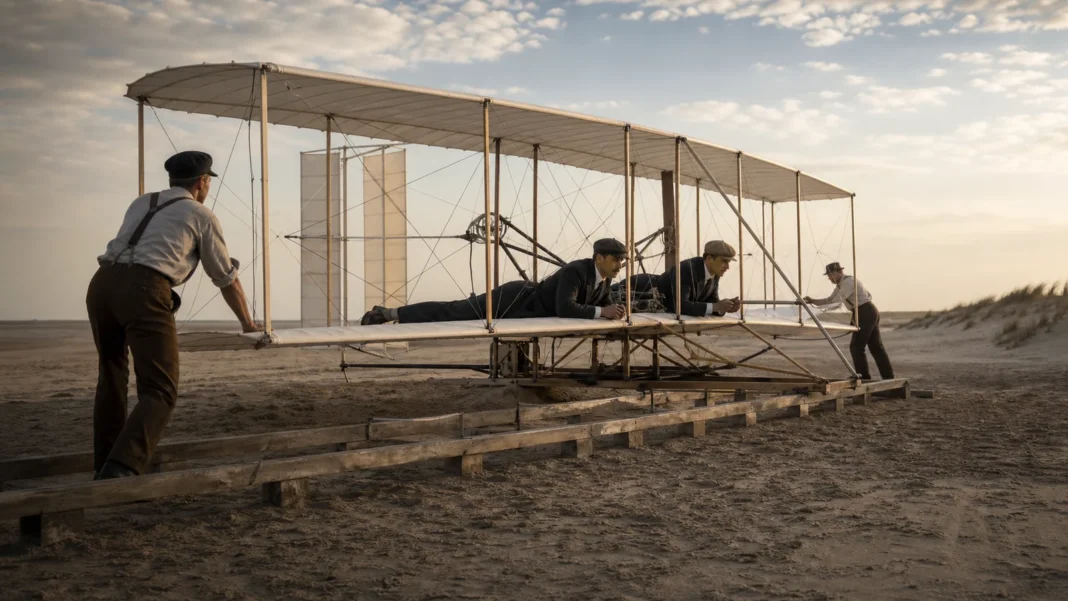

The quick answer: On December 17, 1903, Orville and Wilbur Wright made the first successful flights of a powered, heavier-than-air machine under continuous pilot control. Their decisive achievement was solving how an aircraft could roll, pitch, and yaw in coordinated flight.
The real problem was control
Many experimenters focused on engines or lifting power. The Wrights saw that a useful airplane also had to be steered and balanced. Their work with kites and gliders taught them to treat the pilot as an active part of the system, not a passenger in a machine expected to stabilize itself.
Test the data, not the reputation
When published lift tables did not match their glider results, the brothers built a small wind tunnel in Dayton and tested wing shapes themselves. That evidence improved their wings and propellers. The episode is a compact lesson in innovation: respect earlier work, measure what matters, and revise when the numbers disagree.
Four flights on one cold morning
At Kill Devil Hills, North Carolina, Orville flew first for twelve seconds and 120 feet. The brothers alternated for three more attempts; Wilbur’s final flight covered 852 feet in 59 seconds. A gust damaged the Flyer afterward, but the central problem had been solved.
From bicycle shop to sky
The Wrights combined machining, observation, iterative design, teamwork, and pilot practice. Within two generations, aviation connected cities, carried commerce, transformed national defense, and helped take humans to the Moon. The story remains reassuringly practical: world-changing work can begin with a stubborn question in a modest workshop.
Quick facts
- The first flight took place on December 17, 1903.
- Orville’s first attempt lasted twelve seconds and traveled 120 feet.
- The fourth flight lasted 59 seconds and covered 852 feet.
- Three-axis control—roll, pitch, and yaw—remains fundamental to aviation.
Questions readers ask
Why is this considered the first airplane flight?
The Flyer took off under its own power, carried a person, moved forward under control, and landed at an elevation as high as its starting point.
Were the Wright brothers formally trained engineers?
No. Their experience as printers, machinists, and bicycle builders helped them develop the practical and experimental skills they needed.
Explore the sources
These primary and public-history resources are a good place to continue:
250 Pulse tells the American story with context, confidence, and room for every neighbor.