
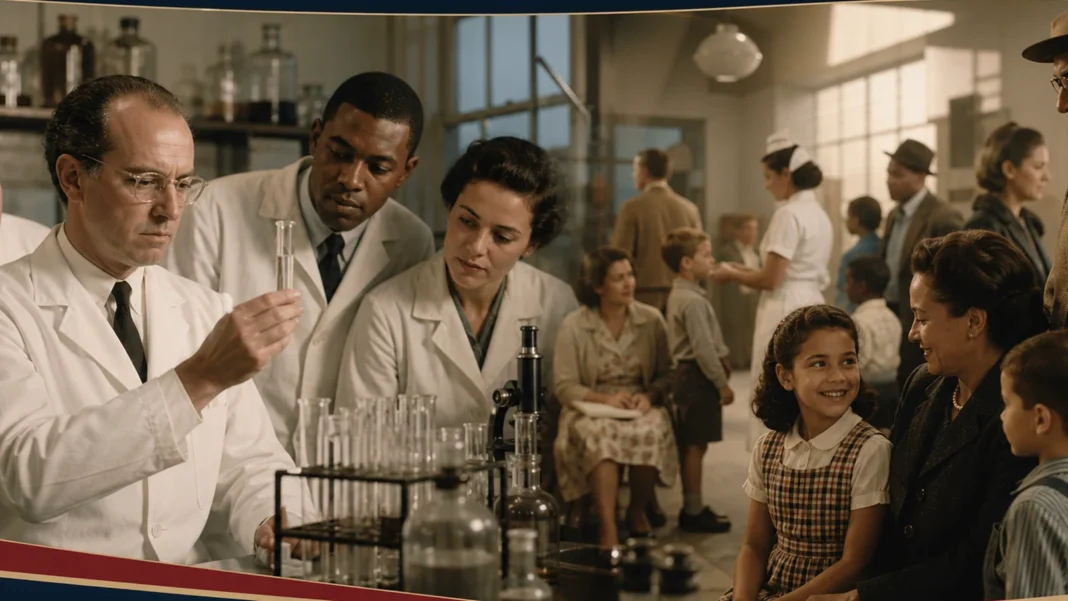

The quick answer: Jonas Salk and his University of Pittsburgh team developed the first effective inactivated polio vaccine. Results announced on April 12, 1955, followed a vast 1954 field trial involving about 1.8 million children.
The fear of polio
Mid-century polio outbreaks could paralyze or kill, especially frightening families during summer epidemics. Patients needing help to breathe relied on iron lungs. The National Foundation for Infantile Paralysis mobilized small donations at national scale, turning public concern into sustained research support.
Science is a relay
Salk’s work depended on discoveries by many researchers, including methods for growing poliovirus in tissue culture. His team developed an inactivated vaccine, while Thomas Francis Jr. led an independent evaluation. Schools, nurses, physicians, laboratories, parents, volunteers, and children all made the trial possible.
The Polio Pioneers
About 1.8 million children participated across the United States, Canada, and Finland. The double-blind trial was unprecedented in scale. When the vaccine was declared safe, effective, and potent in 1955, church bells rang and communities celebrated a scientific result as national news.
Achievement with a duty to remember
A manufacturing failure known as the Cutter incident caused illness and prompted stronger safety controls. Later, Albert Sabin’s oral vaccine became another major tool. The larger American achievement was not one heroic figure but an evolving public-health system willing to test, learn, correct, and keep immunizing.
Quick facts
- The major field trial took place in 1954.
- About 1.8 million children participated.
- Results were announced on April 12, 1955.
- The last U.S. case of indigenously acquired wild poliovirus occurred in 1979.
Questions readers ask
Was Salk the only scientist behind polio vaccination?
No. His team built on earlier research, Francis evaluated the field trial, and Sabin later developed the widely used oral vaccine.
Why was the trial so large?
Researchers needed strong evidence of safety and effectiveness against a disease whose outbreaks varied by place and season.
Explore the sources
These primary and public-history resources are a good place to continue:
- CDC: 50th Anniversary of the First Effective Polio Vaccine
- CDC Museum: Polio and the Epidemic Intelligence Service
250 Pulse tells the American story with context, confidence, and room for every neighbor.