
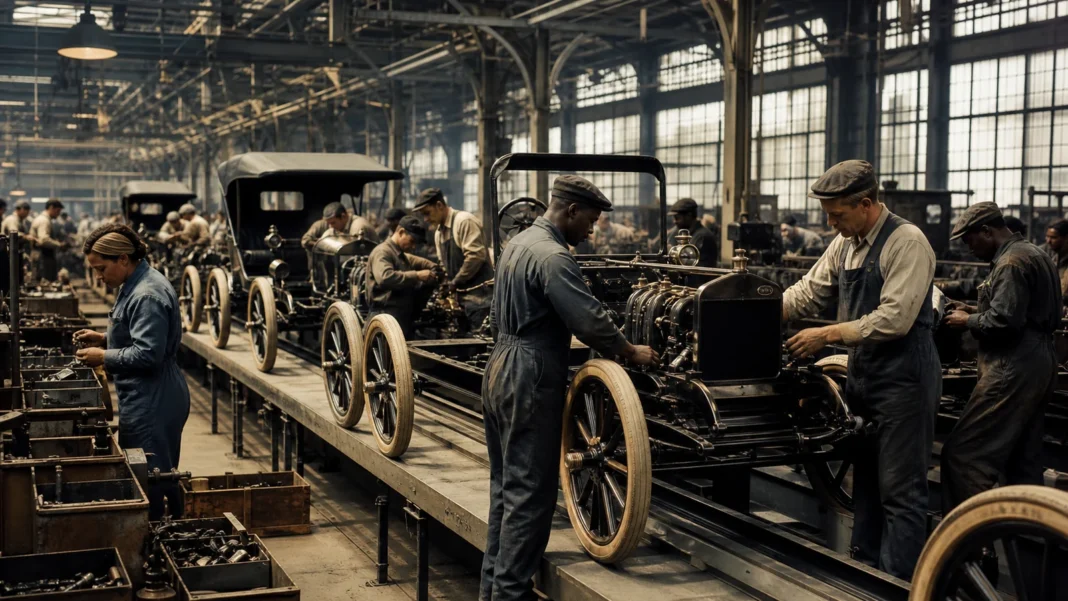

The quick answer: In 1913, Ford Motor Company workers and managers introduced moving assembly-line methods for Model T production at Highland Park, Michigan. Moving the work past specialized stations sharply increased output and helped lower vehicle prices.
Innovation by combination
Conveyors, interchangeable parts, specialized tasks, and continuous-flow ideas existed in other industries. Ford’s achievement was combining and refining them for automobile production at exceptional scale. Experiments began with components such as magnetos before expanding across the plant.
The product moves
Instead of workers circling a stationary automobile, the developing vehicle moved to a sequence of stations. Each task became faster and more repeatable, while supply systems had to deliver the correct part at the correct moment. The factory operated increasingly like one coordinated machine.
Affordability and the worker question
Higher productivity helped reduce the Model T’s price and expanded car ownership. Assembly work could also be repetitive and tightly controlled. Ford’s famous five-dollar day helped recruit and retain workers, but came with intrusive company oversight. Industrial progress produced both consumer opportunity and enduring labor debates.
A system that remade daily life
Mass production influenced appliances, housing, food, wartime manufacturing, and global supply chains. Affordable cars reshaped cities, roads, tourism, retail, and the environment. At 250, the line’s legacy is a useful challenge: design productivity gains so that workers, consumers, communities, and the country share their benefits.
Quick facts
- Ford introduced moving assembly-line methods at Highland Park in 1913.
- The method developed through staged experiments by a team.
- Higher productivity helped lower the Model T’s price.
- The five-dollar workday began in 1914 and drew intense public attention.
Questions readers ask
Did Henry Ford invent the assembly line?
No. Production-line ideas predated Ford. His organization adapted and integrated them into a highly influential system for mass-producing cars.
Why was the Model T important?
Its standardized design, durability, and falling price helped make automobile ownership possible for far more families.
Explore the sources
These primary and public-history resources are a good place to continue:
- Library of Congress: Ford Implements the Moving Assembly Line
- National Museum of American History: Building and Fixing Cars
250 Pulse tells the American story with context, confidence, and room for every neighbor.