
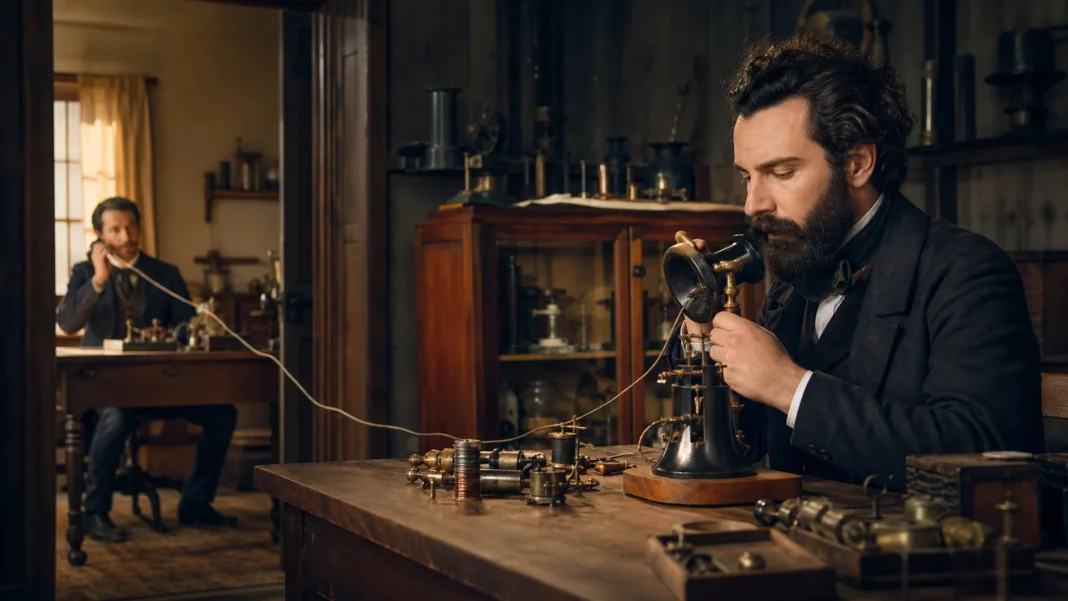

The quick answer: Alexander Graham Bell received a foundational U.S. telephone patent on March 7, 1876, and transmitted intelligible speech to Thomas Watson three days later. The invention emerged from wider research into sound and electrical communication and developed through many contributors.
A life organized around sound
Bell came from a family of speech teachers, taught deaf students, and studied acoustics. His mother and wife were deaf. Work on transmitting multiple telegraph signals led him toward a harder possibility: could electrical current reproduce the complex vibrations of the human voice?
From principle to working device
Bell sought advice from Smithsonian Secretary and physicist Joseph Henry, who encouraged him to continue. With the technical skill of Thomas Watson and amid competing experiments by other inventors, Bell converted theory into devices that could transmit recognizable speech.
A network, not just an object
A telephone is useful when it connects to another. Exchanges, operators, wires, switching systems, standards, and maintenance turned a laboratory instrument into infrastructure. The innovation therefore involved service design, business organization, manufacturing, and human labor as much as a celebrated patent.
Connection keeps changing
Rotary phones, long-distance lines, undersea cables, mobile networks, and internet calling are descendants of the same ambition: make distance less decisive. At 250, the telephone story reminds us that communication technology succeeds when invention, infrastructure, access, and social trust develop together.
Quick facts
- Bell received his major telephone patent on March 7, 1876.
- Bell and Watson transmitted intelligible speech on March 10, 1876.
- The Smithsonian installed telephone service in 1878.
- Telephone networks required operators, exchanges, standards, wires, and maintenance.
Questions readers ask
Did Bell work alone?
No. Watson, Henry, investors, manufacturers, operators, and many competing inventors and engineers were part of the telephone’s development.
Why did Bell study sound?
His family and professional life centered on speech and deaf education, leading him to investigate acoustics and the mechanics of voice.
Explore the sources
These primary and public-history resources are a good place to continue:
- Smithsonian: Alexander Graham Bell’s Large Box Telephone
- National Museum of American History: Studying Sound
250 Pulse tells the American story with context, confidence, and room for every neighbor.