
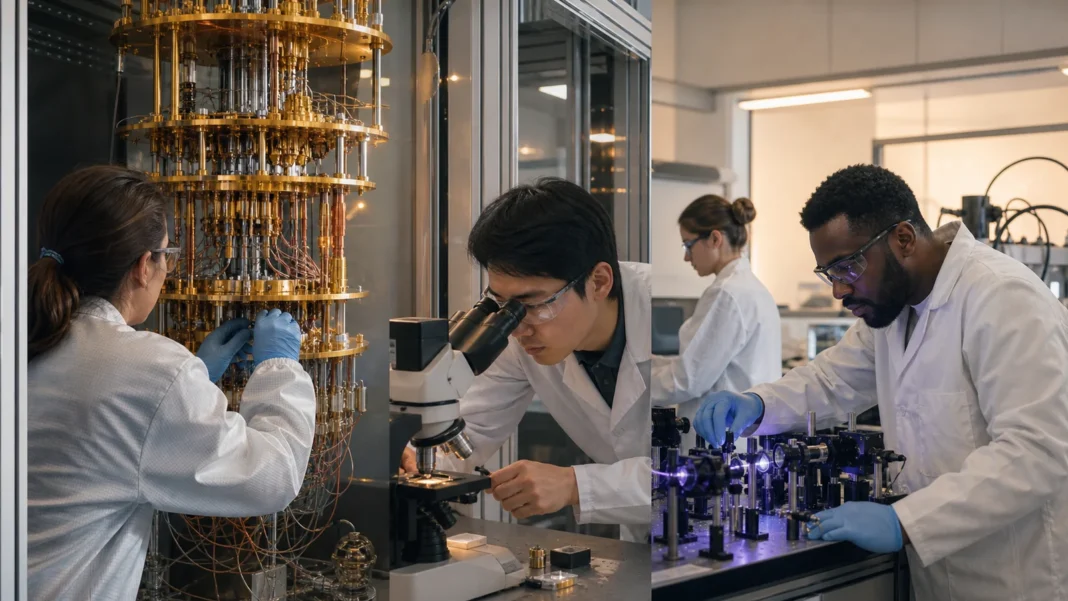

The quick answer: Quantum information science combines quantum physics with information theory. It uses effects such as superposition, entanglement, and precise quantum measurement to develop new forms of computing, sensing, timing, simulation, and communication.
Qubits are not merely smaller bits
A classical bit is recorded as a zero or one. A qubit can be prepared in a quantum state that allows algorithms to manipulate probability amplitudes before measurement. That does not make every calculation faster; potential advantages apply to particular problems and require carefully designed algorithms.
Fragility is the central problem
Quantum states are easily disturbed by heat, vibration, electromagnetic noise, manufacturing defects, and unintended interactions. Researchers use extreme cooling, shielding, calibration, and error-correction techniques. Building useful systems means controlling more qubits without losing accuracy faster than capability grows.
The near-term value is broader
Atomic clocks already support navigation, communications, finance, and measurement. Quantum sensors can improve detection of time, gravity, acceleration, magnetic fields, and light. Networks and secure communications are active fields, while quantum simulation may help researchers understand molecules and materials.
A frontier needs standards and talent
The United States brings national laboratories, universities, startups, established technology companies, and measurement expertise to the field. At 250, success will require patient basic research, engineering talent, realistic benchmarks, secure supply chains, and standards that let results be compared rather than marketed past one another.
Quick facts
- Quantum information science joins quantum physics and information theory.
- Quantum computing is only one part of the field.
- Atomic clocks and quantum measurement already support important infrastructure.
- Noise control and error correction are major obstacles to large-scale quantum computers.
Questions readers ask
Will quantum computers replace ordinary computers?
Probably not. They are expected to complement classical systems for selected workloads rather than handle every everyday task.
Can a quantum computer instantly break all encryption?
No. Large fault-tolerant systems could threaten some public-key methods, but today’s machines are not at that scale and post-quantum standards are being deployed.
Explore the sources
These primary and public-history resources are a good place to continue:
- National Institute of Standards and Technology: Quantum Information Science
- National Quantum Coordination Office
250 Pulse tells the American story with context, confidence, and room for every neighbor.