
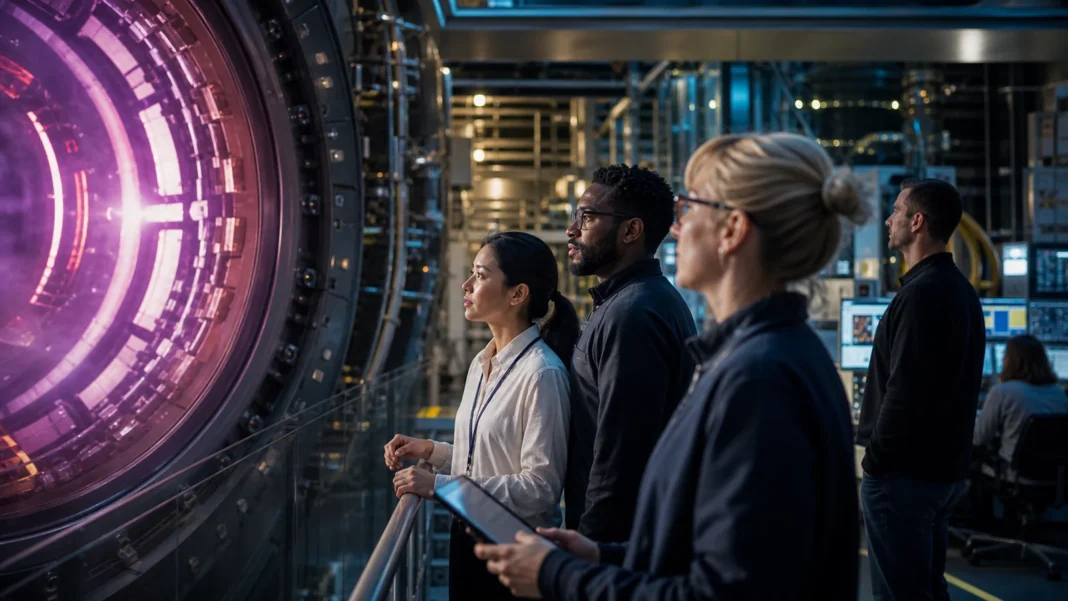

The quick answer: Fusion releases energy when light atomic nuclei combine. Researchers can produce fusion reactions on Earth, but a commercial power plant must repeatedly create controlled reactions, survive extreme conditions, breed or supply fuel, capture heat, maintain equipment, and deliver affordable electricity.
The energy process of stars
Stars use gravity to create fusion conditions. Earth-based systems must use other methods to heat fuel into plasma and confine it. Magnetic-confinement devices such as tokamaks and stellarators use powerful fields; inertial-confinement approaches compress tiny fuel targets with lasers or other drivers.
A scientific milestone is not a power plant
A reaction can produce more fusion energy than reaches the target and still leave the overall facility far from net electrical output. Pumps, magnets, lasers, cooling, fuel production, and power conversion all consume energy. Honest progress depends on clearly stating which boundary a result measures.
The engineering list is formidable
Neutrons damage and activate materials. Components must handle intense heat and be replaced efficiently. Deuterium is available, but many proposed systems need tritium that a plant may have to breed from lithium. Regulators, supply chains, skilled workers, grid connections, cost, and public confidence matter alongside plasma physics.
Why the research is worth doing
Fusion could eventually add firm, low-carbon energy with abundant inputs and no runaway chain reaction. It may also take longer or cost more than advocates hope. At 250, the confident American approach is patient urgency: fund strong science, welcome private experimentation, measure complete systems, publish evidence, and avoid promising a date physics has not earned.
Quick facts
- Fusion combines light nuclei and releases energy.
- Most leading concepts use deuterium and tritium fuels.
- Magnetic and inertial confinement are two major research approaches.
- Commercialization requires whole-plant energy gain, durable materials, fuel-cycle solutions, maintainability, safety, and competitive cost.
Questions readers ask
Is fusion the same as nuclear fission?
No. Fission splits heavy nuclei; fusion combines light nuclei. Their fuels, reactions, waste profiles, and engineering risks differ.
Has fusion already achieved ignition?
Some experiments have met specific scientific ignition or target-gain definitions, but no fusion plant yet supplies commercial electricity to a grid.
Explore the sources
These primary and public-history resources are a good place to continue:
250 Pulse tells the American story with context, confidence, and room for every neighbor.