
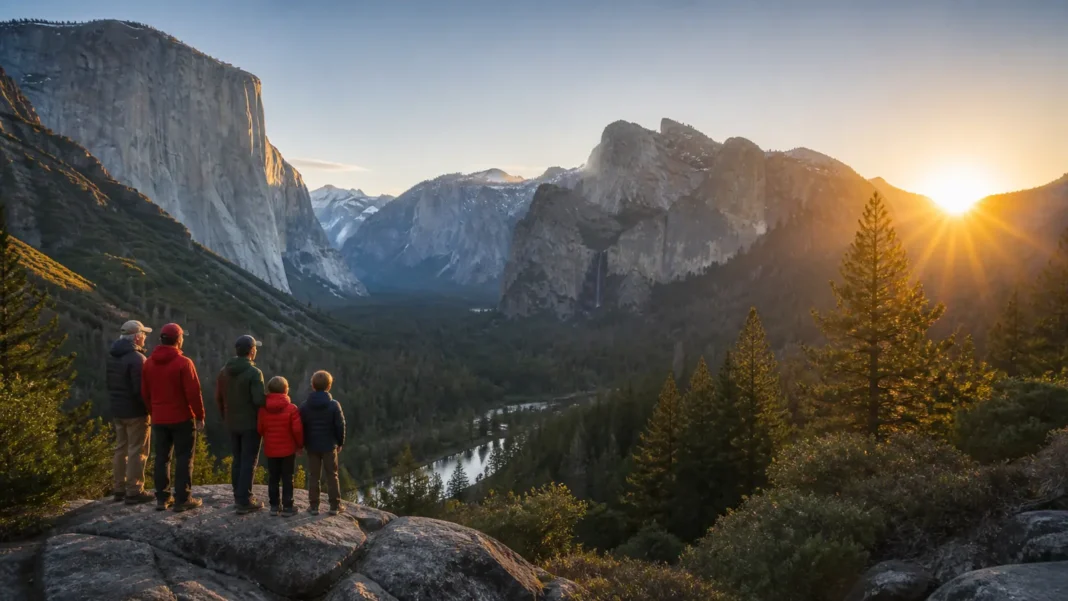

The national parks make a distinctly American claim: some places are so valuable that every generation should receive them, and no generation should use them up.
A visitor can stand beneath a giant sequoia, walk the battlefield at Gettysburg, listen to waves at Cape Hatteras, enter the rooms where civil-rights history changed direction, or watch desert light move across stone in Utah. These experiences differ, yet all take place inside the same public promise.
The National Park System is not a single kind of landscape. It is a map of what Americans have chosen to remember and protect: scenery, wildlife, homes, trails, monuments, shorelines, rivers, battlefields, industrial sites, and stories. At the country’s 250th anniversary, that inheritance offers a patriotic lesson in restraint. Love of place is strongest when it includes the future.
The quick answer
America’s national parks are federally protected natural, historic, cultural, and recreational places managed for public benefit and future generations. The National Park Service manages 433 units covering more than 85 million acres in all 50 states, the District of Columbia, and U.S. territories. The system includes national parks as well as monuments, historic sites, seashores, battlefields, parkways, and other designations.
In this article
- A public inheritance larger than scenery
- The park idea came before the Park Service
- What counts as a national park?
- Protected does not mean frozen in time
- A shared responsibility, not a government-only job
- How to visit with purpose in the 250th year
A public inheritance larger than scenery
The phrase “national park” usually calls up a grand landscape: Yellowstone’s geysers, Yosemite’s granite walls, the Grand Canyon, or the Great Smoky Mountains. Those places are central to the idea, but the National Park System tells a wider national story.
Parks preserve Indigenous homelands and archaeological sites, immigration stations and presidential homes, canals and factories, farms and forts, places of enslavement and emancipation, and landscapes where Americans demanded equal rights. They protect coral reefs, Arctic tundra, tropical forest, desert, prairie, volcanoes, caves, and city greenways.
This breadth matters because a nation is not only the territory it possesses. It is the memory it chooses to keep accessible. A preserved site gives citizens something a textbook cannot: scale, distance, weather, material, and the stubborn fact that history happened in a real place.
The park idea came before the Park Service
Yellowstone was established in 1872, forty-four years before the National Park Service existed. Other parks and monuments followed, but management was scattered among federal agencies. Conservation advocates argued that protected places needed consistent professional care and a public constituency.
On August 25, 1916, President Woodrow Wilson signed the law creating the National Park Service within the Department of the Interior. Known as the Organic Act, it gave the new agency a mission whose central tension still defines park management: conserve scenery, natural and historic objects, and wildlife while providing for public enjoyment in a way that leaves those resources unimpaired for future generations.
Enjoyment and preservation are not competing promises when visitors understand that access carries a duty of care.
The sentence is elegant because it refuses an easy answer. A park closed to everyone would fail its public purpose. A park consumed by its popularity would fail the future. Rangers, scientists, tribes, historians, volunteers, gateway communities, and visitors negotiate that balance every day.
What counts as a national park?
The word “park” is used informally for every unit in the system, but Congress has created at least nineteen official naming designations. A national battlefield may preserve military history. A national seashore protects coast and recreation. A national historical park may connect several related sites. National monuments, memorials, preserves, lakeshores, rivers, trails, and recreation areas each have their own legal histories and management needs.
The system currently includes 433 units and more than 150 related areas, along with programs that support conservation and historic preservation beyond park boundaries. More than 85 million acres fall within National Park Service units. The agency’s reach extends through every state, the capital, and U.S. territories.
Numbers alone do not communicate the variety. The smallest unit may preserve a focused event or structure; the largest protect ecosystems on a continental scale. One place asks a visitor to become quiet in a historic room. Another requires backcountry planning, weather judgment, and days of travel. The common element is not size. It is public significance.
Protected does not mean frozen in time
Parks are living systems and changing communities. Rivers move, coastlines erode, forests burn and regenerate, invasive species arrive, and climate conditions shift. Historic interpretation changes as researchers find records and communities add knowledge that earlier accounts ignored.
The best park stewardship is therefore active. Scientists monitor wildlife and water. Preservation crews work with stone, timber, paint, and soil. Fire teams restore safer ecological patterns where appropriate. Historians build fuller narratives. Tribal nations bring sovereign knowledge and enduring relationships to ancestral landscapes. Accessibility specialists make experiences available to more people without erasing the character of a place.
A mature patriotism welcomes that work. It does not require a park story to stay comfortable or a landscape to look untouched. It asks whether the place is being cared for honestly enough that a future visitor can encounter both beauty and truth.
A shared responsibility, not a government-only job
The federal government holds legal responsibility for national parks, but public stewardship has always been broader. Volunteers maintain trails and help visitors. Nonprofit partners restore buildings and fund educational programs. Scientists at universities contribute research. Gateway businesses depend on healthy parks and influence the quality of a visit. Families teach children how to behave around wildlife and historic objects.
Visitors make hundreds of small decisions that either protect or diminish a place: staying on durable surfaces, respecting closures, storing food correctly, leaving artifacts where they are, keeping distance from animals, reducing noise, and carrying out waste. None of these actions is dramatic. Together they decide whether popularity becomes affection or pressure.
Public land also asks citizens to tolerate one another. A trailhead parking lot can hold license plates from across the country. People arrive with different abilities, backgrounds, beliefs, and expectations. The rules are shared because the inheritance is shared.
How to visit with purpose in the 250th year
Choose one famous park if it has called to you for years—but also find the important place close to home. The nearest National Park Service site may tell a story you did not know belonged to your region. Read the official conditions page before leaving. Reserve timed entry or lodging when required. Build extra time into the day so a delayed shuttle or crowded overlook does not become a reason to take risks.
- Learn whose homeland you are visiting. A landscape’s human history did not begin when it entered the park system.
- Ask a ranger one specific question. Good questions turn scenery into understanding.
- Buy locally in a gateway community. Healthy towns and healthy parks often depend on each other.
- Give one hour back. Join a cleanup, citizen-science activity, friends group, or volunteer program.
- Leave evidence in memory, not on the land. Take photographs; leave rocks, plants, artifacts, and wildlife undisturbed.
The national parks are sometimes called America’s best idea. Perhaps the better phrase is America’s continuing decision. Each generation decides whether spectacular and meaningful places remain common ground. At 250, the view is still ours—and so is the obligation.
Quick facts about the National Park System
How many national parks are in the United States?
The National Park Service manages 433 units. Not all carry the formal designation “National Park”; the system includes monuments, historic sites, battlefields, seashores, recreation areas, and other types of protected places.
When was the National Park Service created?
Congress created the National Park Service in 1916, and President Woodrow Wilson signed the Organic Act on August 25 of that year.
What was America’s first national park?
Yellowstone was established in 1872 and is recognized as the first U.S. national park. It predates the National Park Service by more than four decades.
Are national parks free to enter?
Some are free, while others charge entrance or activity fees. Reservation systems and fees vary, so visitors should check the official page for the specific park before traveling.