
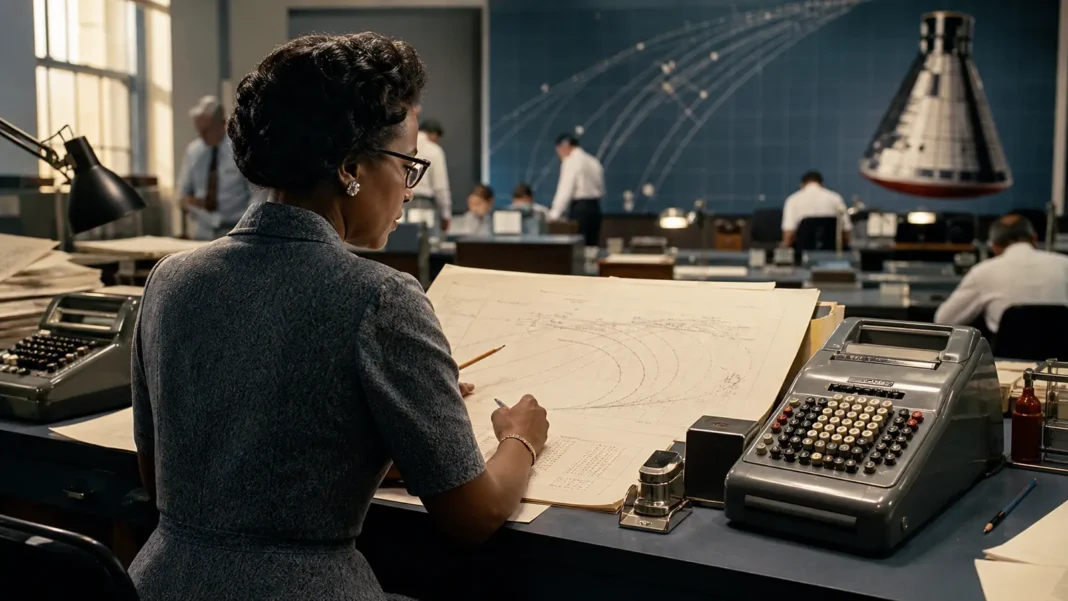

Astronauts supplied the nerve, rockets supplied the force, and Katherine Johnson supplied something every mission needed: a path home.
The romance of spaceflight is vertical—a column of fire, a capsule rising, a human being leaving Earth. The mathematics of spaceflight is curved. A vehicle must arrive at the right place at the right speed, meet a moving planet or spacecraft, survive reentry, and come down where recovery teams can reach it. A tiny error can grow across thousands of miles.
Katherine Coleman Goble Johnson understood those curves. During more than three decades at the organization that became NASA, she calculated and verified trajectories for America’s earliest human spaceflights, helped make orbital missions possible, and contributed to the work that carried Apollo astronauts to the Moon. Her life belongs in the American story not only because she overcame barriers, but because her excellence changed what the country could do.
The quick answer
Katherine Johnson was a pioneering NASA research mathematician whose trajectory calculations supported Project Mercury, John Glenn’s Friendship 7 orbital mission, and the Apollo program. In 1962, Glenn asked for Johnson to verify the electronic computer’s orbital figures by hand before his flight. Her combination of mathematical skill, persistence, and professional judgment helped build trust in a new age of human spaceflight.
In this article
- A mind drawn to numbers
- The door at Langley
- From Freedom 7 to orbit
- The check John Glenn wanted
- Apollo and the way home
- What her example teaches the next generation
A mind drawn to numbers
Johnson was born in White Sulphur Springs, West Virginia, in 1918. Her ability with numbers appeared early, but the local schools did not offer public education for Black children beyond eighth grade. Her family moved during the school year so that the children could continue their education. She entered high school at ten and West Virginia State College at fifteen.
At college, professors recognized unusual talent. She studied every mathematics course available, and faculty members created advanced classes for her. She graduated with highest honors in 1937, taught school, and in 1939 became one of three Black students selected to integrate West Virginia University’s graduate programs. Family responsibilities interrupted that path, but not her appetite for difficult work.
This part of her story is sometimes compressed into the word “gifted.” The word is true but incomplete. Talent met a family willing to move, teachers willing to invest, and a young woman willing to enter rooms where precedent offered little reassurance.
The door at Langley
In 1953, Johnson joined the National Advisory Committee for Aeronautics at Langley Memorial Aeronautical Laboratory in Virginia. NACA employed women as “computers”—people who performed the laborious calculations engineers needed. The unit in which she began was composed of Black women and operated under the segregation rules of the era.
Within weeks, Johnson was assigned to the Flight Research Division. She asked questions, joined technical discussions, and learned the geometry of aircraft and flight testing. When told that women did not usually attend a meeting, she wanted to know whether a rule actually prohibited it. Often, there was no rule. There was only a custom waiting for someone competent enough to challenge it.
Johnson did not ask mathematics to make room for her. She demonstrated that the mission had no room for mathematics without her.
Her success was not a solo escape from a faceless group. Dorothy Vaughan, Mary Jackson, and the women of the West Area Computers formed part of a wider community of skill at Langley. Their work reminds us that institutions often contain more ability than their old habits know how to use.
From Freedom 7 to orbit
The Soviet launch of Sputnik in 1957 accelerated the American space program and redirected Johnson’s work. She performed trajectory analysis for Alan Shepard’s Freedom 7 mission in May 1961, the first American human spaceflight. It was a short suborbital journey, but every phase—launch, flight, reentry, splashdown—required exact planning.
In 1960, Johnson and engineer Ted Skopinski coauthored a technical report on placing a satellite over a selected Earth position. NASA identifies it as the first time a woman in the Flight Research Division received author credit on a research report. The milestone was administrative on paper and substantial in practice: expertise had gained a name.
Orbital flight raised the difficulty. Unlike a short arc, an orbit had to account for a rotating Earth, changing tracking stations, communication links, capsule performance, and a precise reentry corridor. The mission demanded a marriage between new electronic computers and human understanding.
The check John Glenn wanted
For John Glenn’s 1962 Friendship 7 mission, IBM computers had been programmed to calculate the trajectory from liftoff to splashdown. Electronic computing was becoming indispensable, but astronauts were understandably cautious. Machines were new, systems could fail, and Glenn would be sitting on top of the answer.
Glenn asked NASA to have Johnson check the computer’s figures. She worked through the equations by hand and confirmed them. Only then was he ready to go. Friendship 7 circled Earth three times and made Glenn the first American to orbit the planet.
The story is sometimes told as a contest between a brilliant human and an unreliable machine. Its deeper lesson is cooperation. Johnson trusted mathematics enough to interrogate the output, and she understood the mission well enough to know what the numbers meant. Good technology does not eliminate judgment. It gives informed people more powerful tools.
Apollo and the way home
Johnson’s contributions continued through the Apollo era. NASA credits her with work on the trajectory for Apollo 11 and with calculations that helped synchronize the Lunar Module with the Command and Service Module orbiting above the Moon. That rendezvous problem was unforgiving: two vehicles moving around another world had to become one crew again.
She also contributed to procedures that helped provide backup navigation during Apollo 13. After an oxygen tank exploded, the mission became a rescue. The safe return of the crew depended on accumulated engineering knowledge, disciplined teamwork, and the ability to adapt established calculations to an emergency.
Johnson retired in 1986. By then, electronic computers had transformed the workplace, yet the qualities that made her indispensable had not become obsolete: curiosity, precision, the nerve to ask a question, and the humility to check the answer.
What her example teaches the next generation
Johnson received the Presidential Medal of Freedom in 2015, and NASA named a research facility at Langley in her honor. Recognition arrived late, but it reached millions of students who could now see a mathematician at the center of the space story.
Her legacy should not be reduced to inspiration, useful as inspiration can be. She was not important because her story makes science feel welcoming. Science feels more welcoming because she was demonstrably important. She produced work, solved problems, coauthored research, supported missions, and expanded the institution’s idea of who could be authoritative.
America’s 250th is an invitation to remember heroes whose courage looked like concentration. Johnson did not pilot a capsule. She made it possible for pilots to trust the sky. The next Katherine Johnson may be in a small classroom right now, fascinated by a problem other people have not yet learned to see. The patriotic task is to make sure talent finds a door—and that the mission is wise enough to keep it open.
Quick facts about Katherine Johnson
What did Katherine Johnson do at NASA?
She was a research mathematician who calculated and analyzed flight trajectories, launch windows, emergency return paths, and orbital rendezvous problems for major U.S. space programs.
Did John Glenn ask Katherine Johnson to check the computer?
Yes. Before Friendship 7, Glenn asked for Johnson to verify the electronic computer’s orbital calculations by hand. NASA’s biography records that he trusted the figures after she confirmed them.
Did Katherine Johnson work on Apollo 11?
Yes. NASA credits her with trajectory work for the first Moon-landing mission and with calculations related to the rendezvous of the Lunar Module and the orbiting Command and Service Module.
When did Katherine Johnson work at NASA?
She began at NACA’s Langley laboratory in 1953, continued after NACA became NASA in 1958, and retired in 1986.