
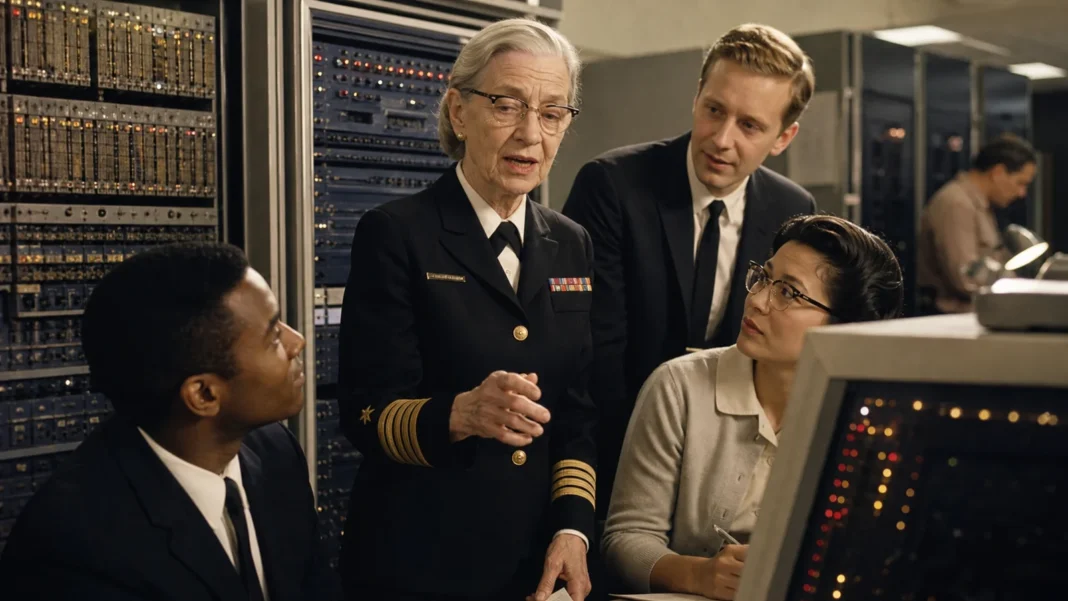

The quick answer: Grace Hopper was a Navy officer and computer scientist whose work on early computers, compilers, and standardized programming languages helped make software more accessible and useful.
Mathematics met a national need
Hopper earned a doctorate in mathematics from Yale in 1934 and taught at Vassar. During World War II, she joined the Navy Reserve and was assigned to the Bureau of Ordnance Computation Project at Harvard, where she learned to program the Mark I.
Early computers were enormous, specialized machines. Programming them demanded patience and a willingness to work at the edge of what the field understood. Hopper brought rigorous mathematics, a teacher’s instinct, and a persistent dislike of unnecessary limits.
The compiler changed the conversation
In the early 1950s, Hopper published pioneering work on compilers—software that translates instructions written in one form into code a machine can execute. The idea helped move programming away from a world in which every instruction had to be expressed close to machine language.
Her larger insight was human-centered: computers would become more valuable if more people could describe problems in a language suited to their work. That principle helped shape later business-oriented languages and the development of COBOL.
Standards let systems work together
Hopper contributed to efforts to standardize computer languages. Standards can look less glamorous than invention, but they allow organizations to share work, maintain systems, and build on common foundations.
The lesson reaches far beyond computing. American innovation often depends on a mixture of bold prototypes and patient coordination. A useful breakthrough is not only clever; it can be explained, repeated, and connected to other people’s work.
A career that kept restarting
Hopper retired from the Navy Reserve in 1966, was recalled in 1967, and continued serving until 1986. She retired as a rear admiral at age 79, then the oldest commissioned officer on active duty in the Navy.
Her career is an American story of second acts and persistent curiosity. At 250, it offers an attractive formula for the future: teach what you learn, question habits that have lost their purpose, and keep technical progress connected to the people who must use it.
Quick facts
- Hopper programmed the Harvard Mark I during World War II.
- She published early work on compilers and helped advance machine-independent programming.
- She was instrumental in the development and standardization of COBOL.
- She retired from the Navy as a rear admiral in 1986 at age 79.
Questions readers ask
Did Grace Hopper invent the word “bug” for a computer error?
No. The term existed earlier. A moth found in a Mark II relay became a famous literal example of debugging, and Hopper’s team preserved it in the logbook.
Why were compilers important?
They helped programmers express instructions in more human-friendly forms and let software translate those instructions into code a computer could execute.
Explore the sources
These primary and public-history resources are a good place to continue:
- Naval History and Heritage Command: Grace Murray Hopper
- Naval History and Heritage Command: Rear Admiral Grace Hopper
250 Pulse tells the American story with context, confidence, and room for every neighbor.