

The quick answer: Clara Barton helped define American humanitarian service by caring for wounded soldiers, locating missing men, and founding the American Red Cross in 1881.
Service came before the title
Long before she founded a national institution, Clara Barton worked as a teacher and as one of the first women employed by the federal government in a role comparable to male clerks. When the Civil War began, she gathered supplies for soldiers and pushed past conventions that kept women away from battlefront care.
Barton became known for bringing food, bandages, and nursing assistance close to wounded troops. Her work was personal, but never casual. She kept learning how supplies moved, where systems failed, and what frightened people needed in the next hour.
The Missing Soldiers Office answered families
After the war, Barton led an effort to identify missing Union soldiers and respond to families who had waited without reliable news. The work required records, correspondence, persistence, and respect for grief. It was humanitarian service conducted through information.
That chapter of her life is easy to overlook, yet it shows the same instinct that later shaped disaster relief: people in crisis need more than sympathy. They need organized facts, accountable follow-through, and someone willing to keep the unanswered question in view.
Building an American Red Cross
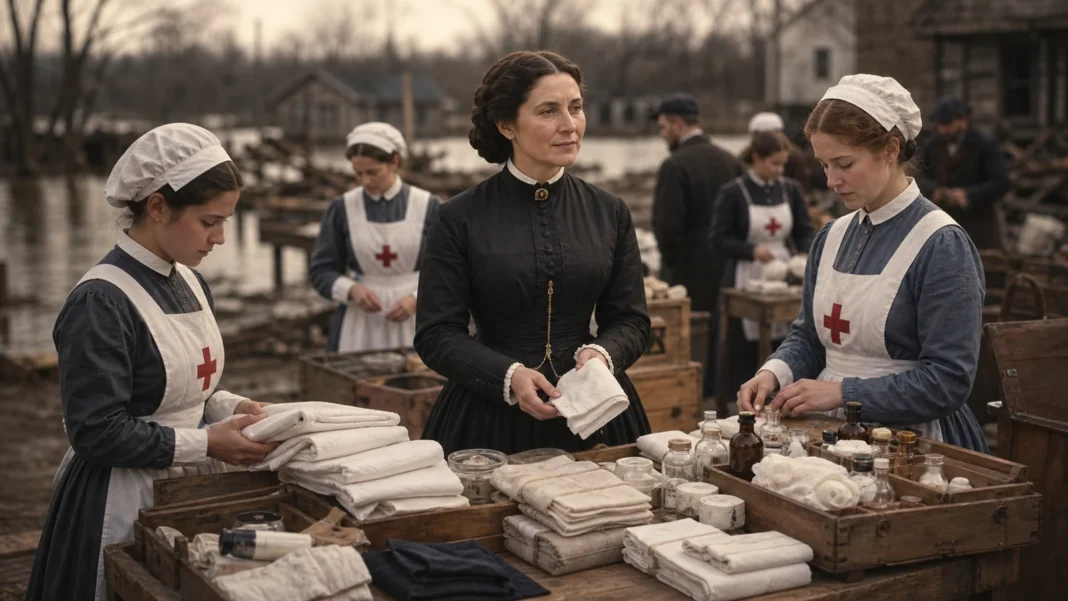
After seeing the International Red Cross movement in Europe, Barton advocated for an American society. She founded the American Red Cross in 1881 and led it through responses to floods, fires, hurricanes, and other emergencies as well as wartime relief.
The American organization developed a distinctive emphasis on peacetime disasters. That practical adaptation helped make relief a continuing civic capacity rather than an improvised response reserved for war.
Compassion needs structure
Barton’s legacy is not that institutions replace neighbors. It is that institutions can help generous neighbors coordinate, train, store supplies, share information, and reach beyond the distance one person can cover alone.
The United States at 250 inherits a vast culture of emergency volunteers and professional responders. Barton’s example reminds us that the national instinct to help is strongest when good will is joined to preparation. Kindness moves first; organization helps it endure.
Quick facts
- Barton brought supplies and care to wounded soldiers during the Civil War.
- Her Missing Soldiers Office helped families seek information after the war.
- She founded the American Red Cross in Washington, D.C., in 1881.
- She led the organization for more than two decades.
Questions readers ask
Did Clara Barton create the international Red Cross movement?
No. The international movement began in Europe. Barton brought its principles to the United States and helped shape an American organization with a strong peacetime disaster mission.
What made her leadership distinctive?
She combined direct care with logistics, records, advocacy, and institution-building—turning compassion into a repeatable public service.
Explore the sources
These primary and public-history resources are a good place to continue:
250 Pulse tells the American story with context, confidence, and room for every neighbor.