
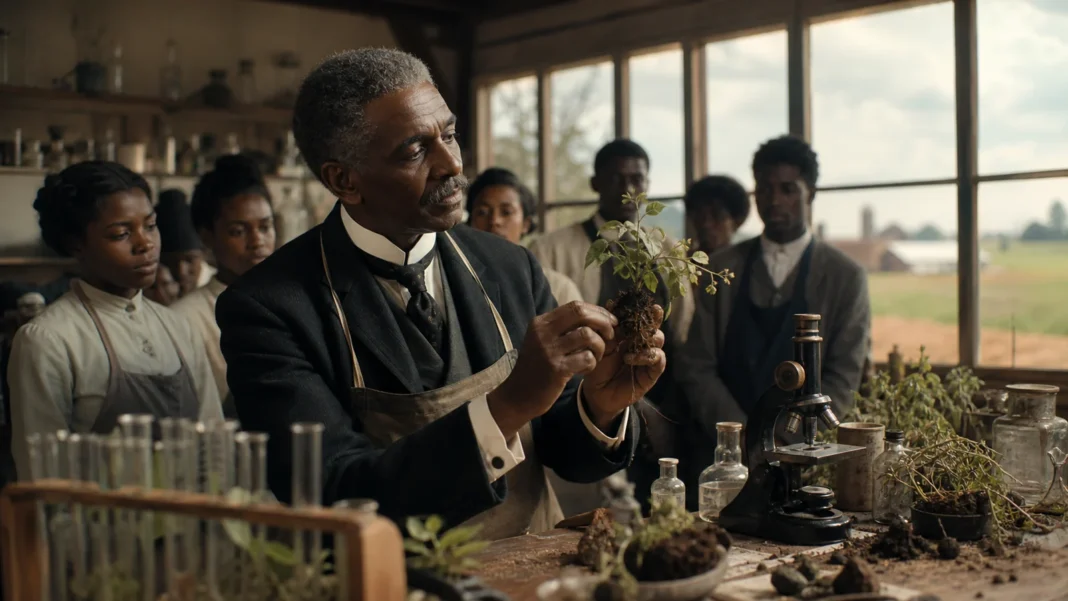

The quick answer: George Washington Carver’s lasting achievement was not a single famous product. It was a model of science directed toward healthier soil, better farm practice, education, and economic opportunity.
Curiosity survived every obstacle
Born enslaved in Missouri near the end of the Civil War, Carver pursued education across towns and states where schooling for Black students was limited or denied. His path eventually led to Iowa State Agricultural College, where he earned bachelor’s and master’s degrees in agriculture.
That long search matters because it shaped how he understood knowledge. Education was not a private ornament. It was a resource worth carrying outward, especially to people whose choices had been narrowed by poverty, exhausted land, or discrimination.
A laboratory connected to the field
Carver joined Tuskegee Institute in 1896 and worked there for nearly five decades. Southern farmers depended heavily on cotton, a crop that depleted soil and left families vulnerable to price changes. Carver taught crop rotation and encouraged peanuts, sweet potatoes, and other alternatives that could restore nutrients and diversify farm income.
His research addressed an immediate human question: what could families do with the crops they were being asked to grow? The many recipes, household uses, and industrial experiments associated with Carver were ways to connect agricultural reform with practical demand.
The Jesup Wagon took learning outside
In 1906, Carver and Tuskegee colleague Thomas Monroe Campbell helped launch a movable school later known as the Jesup Wagon. It brought demonstrations about crops, nutrition, sanitation, and farm practice into rural communities rather than waiting for farmers to reach a campus.
That approach feels strikingly modern. Good innovation is not finished when a discovery works in controlled conditions. It has to be understandable, affordable, and useful where people actually live. Carver treated delivery and teaching as part of the invention.
A patriotic science of stewardship
Carver’s public image sometimes collapses into exaggerated lists of peanut products. His deeper legacy is more substantial: careful observation, regenerative practice, accessible education, and service to farmers whose needs were often ignored.
At America’s 250th, his story broadens the meaning of national achievement. Progress can be a laboratory breakthrough, but it can also be the patient work of rebuilding soil, sharing knowledge, and giving communities more ways to stand on their own.
Quick facts
- Carver became the first Black student at Iowa State and earned a master’s degree in agricultural science in 1896.
- He joined Tuskegee Institute as director of agriculture in 1896.
- His teaching emphasized crop rotation and alternative crops for soil health and farm resilience.
- Congress authorized George Washington Carver National Monument shortly after his death in 1943.
Questions readers ask
Did George Washington Carver invent peanut butter?
No. Peanut paste existed before Carver’s work. His importance lies in agricultural research, practical applications for alternative crops, and decades of teaching.
What was the Jesup Wagon?
It was a movable agricultural school that brought demonstrations and practical instruction from Tuskegee into rural communities.
Explore the sources
These primary and public-history resources are a good place to continue:
250 Pulse tells the American story with context, confidence, and room for every neighbor.