
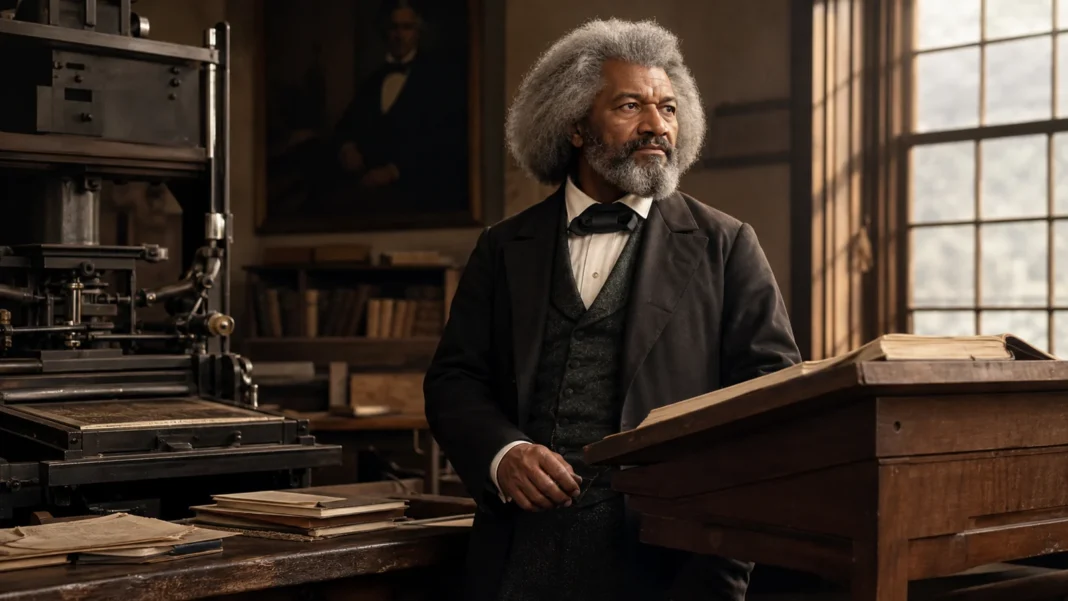

The quick answer: Frederick Douglass transformed personal testimony into public action, using speeches, newspapers, books, and government service to argue that American liberty must belong to every person.
Learning was an act of independence
Douglass was born enslaved in Maryland in 1818. As a boy in Baltimore, he began learning to read even though Maryland law and slaveholding custom treated Black literacy as a threat. That reaction revealed an important truth: knowledge could widen the imaginable world and weaken the authority of those who claimed permanent control.
He continued teaching himself, learning not only how sentences worked but how public arguments were built. Literacy did not end his enslavement, but it gave him tools to understand the system, describe it, and prepare for a life beyond it.
A witness found a public voice
After escaping slavery in 1838, Douglass settled in New Bedford, Massachusetts. His ability as a speaker soon drew attention in the abolitionist movement. Audiences encountered something the defenders of slavery tried to deny: an intellectually commanding man describing the institution from lived experience.
His 1845 autobiography made that testimony portable. Readers across the United States and abroad could no longer treat slavery as an abstraction. Douglass paired moral force with precise observation, showing how violence, enforced ignorance, and family separation sustained the system.
The press became civic infrastructure
In 1847, Douglass founded The North Star. The newspaper allowed him to set an agenda, respond to events, and cultivate Black political thought beyond the limits of a lecture tour. Publishing was not simply self-expression; it was a way to build a public capable of acting together.
Douglass argued, debated allies, changed positions, and kept writing. That willingness to reason in public is central to democratic life. A free press does more than distribute information. At its best, it helps citizens examine national claims against national conduct.
An American argument left open
During the Civil War, Douglass urged emancipation and the enlistment of Black soldiers, including men who joined the 54th and 55th Massachusetts regiments. After the war, he held federal posts and continued advocating for equal rights and women’s suffrage.
His patriotism was neither complacent nor cynical. He treated the principles in America’s founding language as claims the country could be made to honor. That posture remains useful at 250: love of country can include honest measurement, sharp criticism, and faith that fellow citizens are capable of better.
Quick facts
- Douglass escaped slavery in 1838 and settled in New Bedford, Massachusetts.
- He published the first of three autobiographies in 1845.
- He founded the abolitionist newspaper The North Star in 1847.
- He later served as U.S. marshal for the District of Columbia and U.S. minister to Haiti.
Questions readers ask
Why was literacy so important in Douglass’s life?
Reading and writing helped him interpret the system that enslaved him, communicate his experience, and participate directly in the political arguments of his time.
Did Frederick Douglass support women’s rights?
Yes. Douglass was a lifelong advocate for women’s rights and attended a women’s suffrage meeting on the day he died in 1895.
Explore the sources
These primary and public-history resources are a good place to continue:
- Library of Congress: Frederick Douglass biography
- Library of Congress: Frederick Douglass in his own words
250 Pulse tells the American story with context, confidence, and room for every neighbor.