
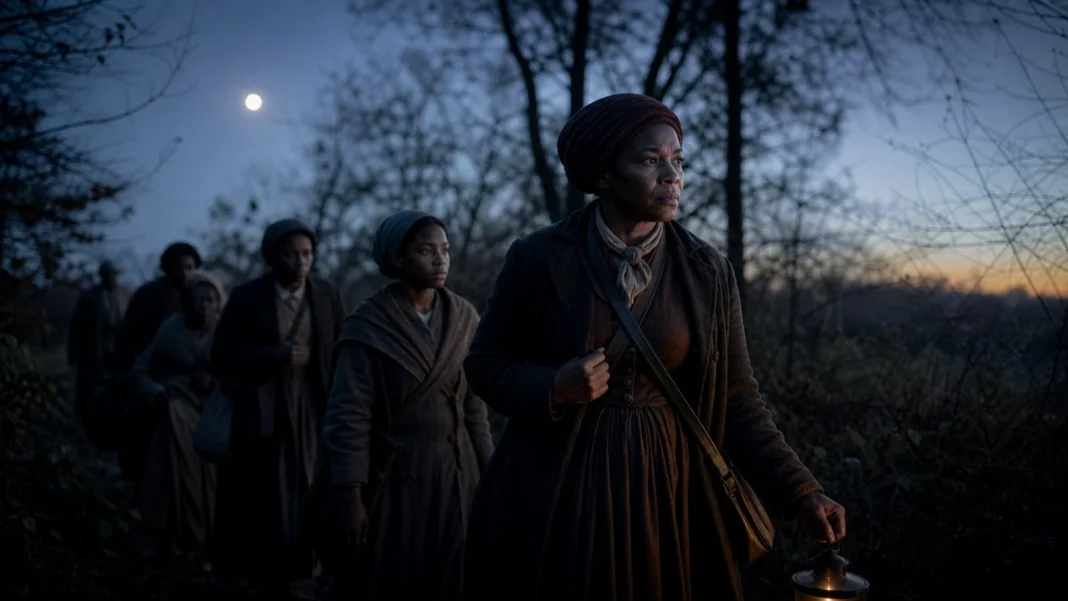

The quick answer: Harriet Tubman is remembered not only because she escaped slavery, but because she repeatedly returned to help family and friends reach freedom, then served the Union and supported women’s suffrage.
Freedom became a mission
Born enslaved on Maryland’s Eastern Shore around 1822, Tubman grew up inside a system designed to control movement, family, education, and work. Her escape in 1849 was therefore more than a change of address. It was a deliberate claim to ownership of her own life.
The most revealing part of her story came next. Tubman went back. Over roughly a decade, she made about 13 trips into Maryland and personally guided around 70 people toward freedom. She also shared instructions that helped many others make the journey. Her heroism was practical: routes learned, timing judged, trust earned, and fear mastered one decision at a time.
Courage worked through a plan
Popular memory sometimes turns the Underground Railroad into a single trail. In reality, it was a changing network of people, homes, waterways, roads, and hard choices. Tubman’s knowledge of the Eastern Shore landscape mattered, as did her ability to read a situation and keep a group moving quietly.
That combination of moral clarity and preparation is part of her enduring power. She did not wait for history to become safe. She learned what the mission required, accepted responsibility for others, and acted with discipline. Courage, in her example, was not the absence of danger; it was the refusal to surrender purpose to danger.
Her service widened during the Civil War
During the Civil War, Tubman worked in South Carolina as a nurse, scout, and spy for the Union. In June 1863, she joined the Combahee River Raid, which helped free more than 700 enslaved people. Many of the men later joined the Union Army.
The raid shows how her experience translated into national service. The skills developed while guiding families—local knowledge, discretion, communication, and resolve—became assets in a military campaign against slavery. Her life resists a narrow label because her work kept expanding wherever freedom needed an advocate.
A lifetime of active citizenship
After the war, Tubman continued caring for family and community in Auburn, New York. She also supported the campaign for women’s suffrage and established a home for older African Americans. Freedom, to her, was not complete when one person crossed a boundary; it required a society in which people could live with dignity.
At America’s 250th anniversary, Tubman’s example offers a demanding but hopeful patriotism. The nation is strengthened by people who see a promise, recognize where reality falls short, and take responsibility for closing the distance. Her story asks what freedom becomes when we treat it as something to protect for a neighbor as well as ourselves.
Quick facts
- Tubman was born Araminta Ross in Dorchester County, Maryland, around 1822.
- The National Park Service credits her with about 13 return trips and personally guiding roughly 70 people to freedom.
- She served the Union as a nurse, scout, and spy during the Civil War.
- She was buried with military honors in Auburn, New York, in 1913.
Questions readers ask
Was Harriet Tubman the only conductor on the Underground Railroad?
No. The Underground Railroad depended on many Black and white participants, free communities, and local networks. Tubman became its best-known conductor because of her repeated journeys, leadership, and later public service.
Why does her story still matter?
It connects individual liberty with responsibility for others. Tubman’s life shows that American ideals become durable when people turn conviction into prepared, sustained service.
Explore the sources
These primary and public-history resources are a good place to continue:
250 Pulse tells the American story with context, confidence, and room for every neighbor.