
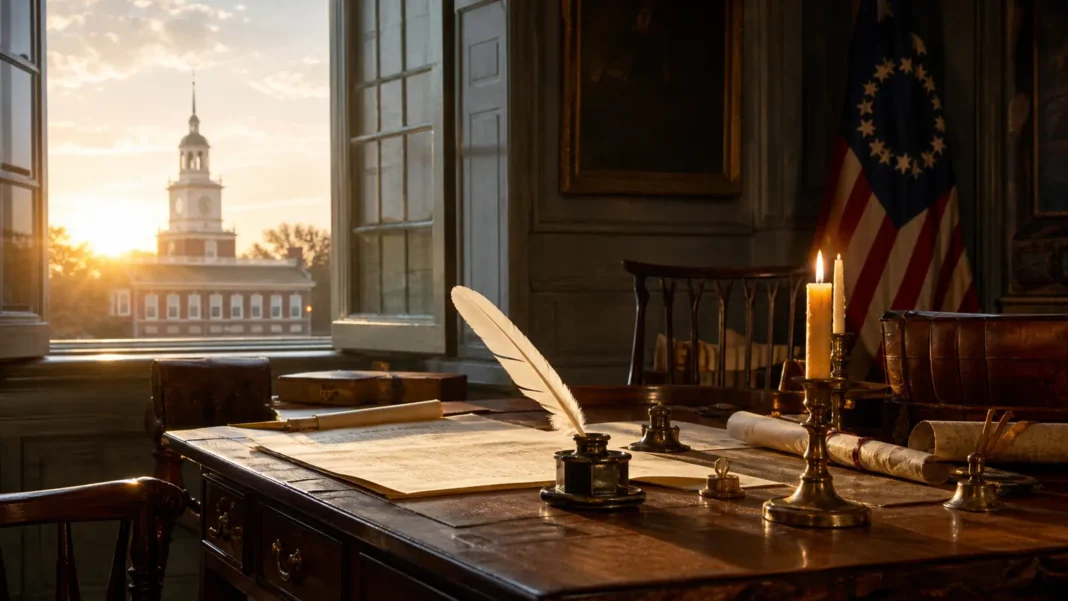

The Declaration of Independence did not finish the American argument. It gave Americans a language for continuing it.
The parchment displayed at the National Archives is faded, creased, and guarded behind carefully controlled glass. The ideas it carries are anything but fragile. Equality, natural rights, government by consent, and the right of a people to change a government that betrays its purpose have traveled far beyond the summer of 1776.
As the United States marks its 250th anniversary, the Declaration deserves more than ceremonial admiration. It deserves to be read as the daring public argument it was—and as a standard each generation inherits. Patriotism is not diminished by measuring the country against its own words. That act of measurement is one of the most American things citizens can do.
The quick answer
The Declaration of Independence matters today because it explains both why the United States became independent and what legitimate government is for. Adopted by the Continental Congress on July 4, 1776, it argues that people possess rights, that governments derive authority from consent, and that public power must answer to the people. It is not a statute, but its principles became a moral vocabulary for American democracy and reform.
In this article
- Not a simple origin story
- A five-part argument, not a slogan
- An expression of the American mind
- The power of an unfinished promise
- The parchment survived because people carried it
- How to read the Declaration in 2026
Not a simple origin story
By June 1776, the colonies were already at war with Great Britain. Independence was not a sudden flash of rhetoric; it was the conclusion of a long political breakdown. The Second Continental Congress had created an army, issued currency, and taken on responsibilities of government. Richard Henry Lee introduced a resolution for independence on June 7. Four days later, Congress appointed John Adams, Benjamin Franklin, Thomas Jefferson, Robert R. Livingston, and Roger Sherman to prepare a declaration.
Jefferson drafted the text, Adams and Franklin suggested changes, and Congress debated and edited it. The vote for independence came on July 2. The text was adopted on July 4, and printer John Dunlap worked through the night to produce broadsides that could carry the news. The famous engrossed parchment was signed beginning on August 2. The familiar date is therefore not the whole story; it is the center of a sequence in which debate became decision and decision became a public pledge.
The Declaration was both an announcement to the world and a promise the nation would spend centuries learning how to keep.
A five-part argument, not a slogan
The National Archives describes five parts in the Declaration: an introduction, a preamble, two sections of the body, and a conclusion. That structure matters. The document does not simply announce separation. It says why separation requires explanation, states principles of legitimate government, presents charges against the king, recounts failed appeals, and then declares the colonies free and independent states.
The best-known sentences appear in the preamble, but they gain force from the argument around them. Rights are not presented as gifts from a ruler. Government is a human institution created to secure them. Authority rests on the consent of the governed. When power becomes destructive of those purposes, the people retain responsibility for their political future.
That is a demanding view of citizenship. It rejects both passive obedience and casual disorder. A people who claim the right to self-government also claim the duty to deliberate, organize, build institutions, and accept the consequences of public choices. Independence was not an escape from responsibility. It was an enormous assumption of it.
An expression of the American mind
Jefferson later said he had not been trying to invent new principles. He wanted the Declaration to be an “expression of the American mind.” He drew on the Virginia Declaration of Rights, Enlightenment political thought, colonial experience, and arguments already circulating among Americans.
That does not make the language less remarkable. It makes the document a work of synthesis: familiar ideas arranged with unusual clarity at a moment of danger. The committee, the Congress, the printers, the messengers, and the citizens who heard the words read aloud all helped turn a draft into a national act.
The phrase also explains why the Declaration belongs to more than its principal author. No founder owned its ideals. Once published, the words entered public life. Americans who had been excluded from the political community could—and did—claim the principles for themselves.
The power of an unfinished promise
The men who adopted the Declaration did not create a society that fully practiced its stated equality. Slavery remained, women lacked political rights, Native nations faced dispossession, and the franchise was narrow. That contradiction is essential history. It is also part of the document’s later power.
Abolitionists, suffragists, civil-rights leaders, workers, immigrants, and reformers repeatedly used founding language to make claims on the country. They did not have to invent a separate American vocabulary of human dignity. They could point to the nation’s own public standard and insist that the circle of liberty grow wider.
An unfinished promise is not the same thing as an empty promise. Empty words ask nothing of anyone. The Declaration’s words created a test that institutions and citizens could fail—and a direction in which they could move. The gap between principle and practice became a source of criticism, but also a source of energy.
The parchment survived because people carried it
The physical Declaration has had an adventurous life. It moved with the Continental Congress during the Revolution, traveled by wagon and ship, was hidden from British forces in 1814, and spent years in conditions that conservation experts would now consider hazardous. It was rolled, exposed to light, displayed, copied, and moved again before reaching the National Archives in 1952.
Its survival is a useful national metaphor. Institutions endure because somebody accepts custody. A clerk packs records before an invading army arrives. An archivist argues for safer storage. A scientist monitors the parchment for changes invisible to the eye. Public memory survives through ordinary competence repeated across generations.
Citizenship works the same way. The grand words matter, but continuity depends on people who maintain election systems, teach history, serve on juries, report facts, keep local records, repair public buildings, and hand inherited knowledge to someone younger.
How to read the Declaration in 2026
Start with the full text, not only the famous sentence. Notice the movement from universal principle to specific grievance and from grievance to collective action. Ask which claims are timeless, which belong to the circumstances of 1776, and how the authors understood the relationship between rights and public power.
Then read it locally. Where does consent become real in your town, county, school district, tribe, or state? Which institutions protect rights? Where can a citizen participate before anger hardens into contempt? The Declaration speaks at a national scale, but self-government is practiced in rooms small enough for people to recognize one another.
At 250, the most fitting tribute is neither worship nor dismissal. It is intelligent custody. Learn the history, cherish the achievement, tell the whole story, and keep the promise moving. The document belongs to every American because the responsibility it announces has never stopped being ours.
Quick facts about the Declaration of Independence
Who wrote the Declaration of Independence?
Thomas Jefferson wrote the principal draft as a member of the Committee of Five. John Adams and Benjamin Franklin suggested changes, and the Continental Congress debated and revised the text before adopting it.
Was independence declared on July 4, 1776?
Congress approved the resolution for independence on July 2 and adopted the Declaration’s text on July 4. The engrossed parchment was signed beginning on August 2.
Is the Declaration of Independence a law?
No. It is a founding political document rather than a statute or part of the Constitution. Its principles nevertheless have had enormous moral, political, and historical influence.
Where is the original Declaration?
The engrossed parchment is displayed in the Rotunda for the Charters of Freedom at the National Archives in Washington, D.C.