
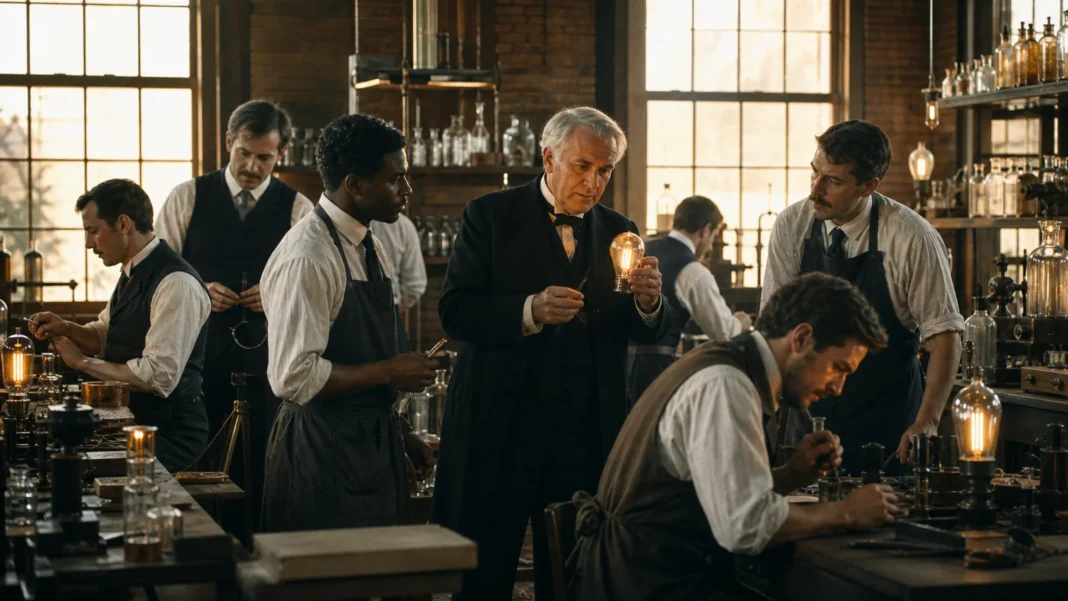

The quick answer: Thomas Edison established his Menlo Park laboratory in New Jersey in 1876. The facility brought equipment and skilled assistants together for continuous experimentation, helping pioneer the organized research-and-development laboratory.
The laboratory as an invention
Edison created a place prepared to investigate many problems instead of a workshop organized around one trade. Chemistry, mechanics, electrical work, drafting, glassblowing, recordkeeping, and machine tools could interact. The lab itself became a platform for producing inventions.
The team behind the Wizard
Newspapers loved the solitary Wizard of Menlo Park, but the work depended on assistants often called muckers. They built prototypes, ran tests, measured materials, repeated experiments, and translated concepts into manufacturable parts. Edison directed and contributed intensely, yet the output was collective.
From bulb to system
Edison did not invent the first electric lamp. His team developed a practical incandescent lamp as part of a complete system that included generators, wiring, meters, sockets, and distribution. In 1882, the Pearl Street station supplied customers in lower Manhattan. The useful innovation was an ecosystem.
The modern R&D pattern
Corporate laboratories, university partnerships, startup teams, and government research programs still combine specialized people around shared tools and stubborn problems. Menlo Park’s enduring lesson is that invention can be organized—not guaranteed, but made more likely through resources, documentation, iteration, and collaboration.
Quick facts
- Edison established the Menlo Park laboratory in 1876.
- The phonograph was developed there in 1877.
- A practical incandescent-lighting system was demonstrated in 1879.
- The Pearl Street generating station began serving customers in 1882.
Questions readers ask
Did Edison invent the light bulb by himself?
No. Many inventors worked on electric lighting, and Edison’s practical system was developed with a laboratory team and an industrial network.
Why is Menlo Park called an invention factory?
It assembled people, tools, materials, testing, and manufacturing knowledge in a deliberate system for repeated research and development.
Explore the sources
These primary and public-history resources are a good place to continue:
250 Pulse tells the American story with context, confidence, and room for every neighbor.