
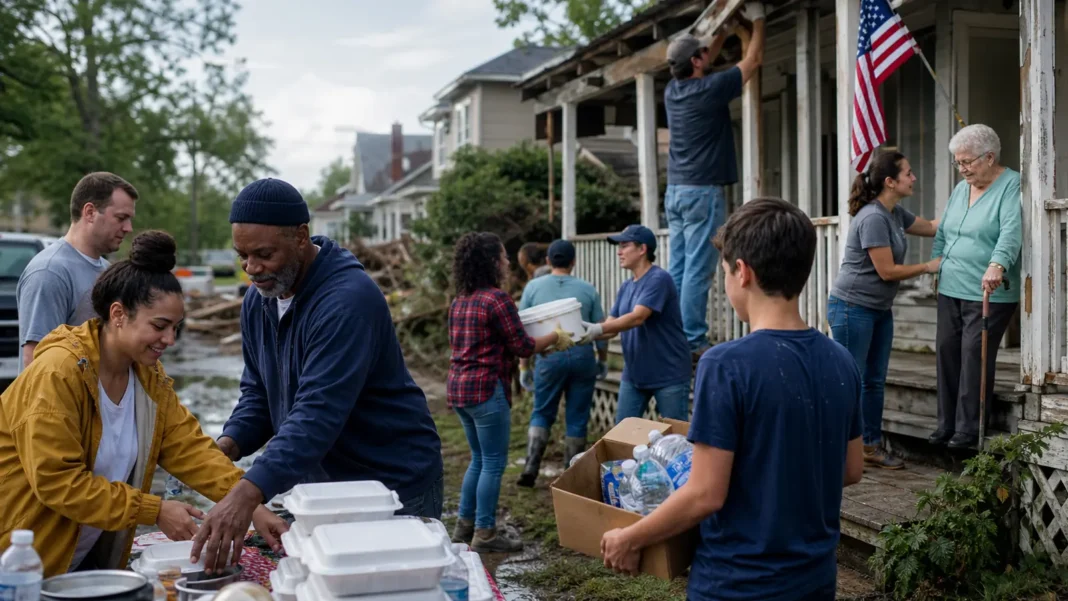

A republic is held together not only by laws and elections, but by the moment somebody notices that a neighbor needs a hand—and shows up.
American volunteerism is easy to overlook because much of it happens without ceremony. It is the parent setting out folding chairs before a school event, the retired accountant helping a food pantry with its books, the teenager clearing brush from a trail, the firefighter answering a pager at dinner, and the neighbor who keeps an extra key for the family next door.
These acts differ in scale, skill, and setting. Together they form civic infrastructure: relationships that help communities absorb trouble, welcome newcomers, preserve local institutions, and solve problems before every answer must come from far away. In the year of America’s 250th anniversary, service offers a positive patriotism anyone can practice.
The quick answer
The American volunteer tradition is the habit of giving time, skill, or practical help for the common good—through organizations or directly to neighbors. Census Bureau and AmeriCorps research found that 75.7 million people, or 28.3% of Americans age 16 and older, formally volunteered between September 2022 and September 2023. Another 54.2% helped neighbors informally. Volunteerism turns national belonging into local action.
In this article
- Service before the spotlight
- Two kinds of help, one civic culture
- What the numbers show
- Resilience is built before the emergency
- The power of a small commitment
- How to start serving where you live
Service before the spotlight
Long before the United States had a large professional public sector, communities depended on associations. Congregations cared for families in distress. Neighbors raised barns and harvested crops. Volunteer militias, fire companies, libraries, mutual-aid societies, hospitals, and civic clubs filled needs that no household could meet alone.
The institutions changed as the country grew, but the associational habit survived. Americans formed abolition societies, fraternal orders, settlement houses, veterans’ groups, youth organizations, conservation clubs, parent-teacher associations, rescue squads, and thousands of local nonprofits. Government and markets did indispensable work; voluntary action connected that work to human attention.
Service is sometimes described as generosity flowing in one direction—from a helper to a recipient. In healthy communities, the current moves both ways. The person who stacks boxes today may need a meal next winter. The neighbor receiving help after a storm may be the one with a chainsaw when the next tree falls. Participation replaces the hard line between giver and receiver with a more accurate idea: citizens taking turns.
Two kinds of help, one civic culture
Researchers distinguish formal volunteering from informal helping. Formal volunteering happens through an organization: coaching a recreation team, reading at a library, serving with a rescue organization, or preparing meals through a nonprofit. Informal helping happens directly: lending tools, running an errand, watching a child, clearing a sidewalk, or checking on an older neighbor.
The distinction is useful because organizations can train people, coordinate risk, match skills to needs, and sustain work over time. Informal help is equally important because it moves quickly and rests on trust. A neighborhood where people know one another can recognize trouble before an institution receives a request.
Digital service now joins both worlds. In 2023, the national survey measured virtual volunteering for the first time. Eighteen percent of formal volunteers served at least partly online. A person can mentor a student, translate a document, design a flyer, help with data, or staff a support line without living near the organization. Technology can thin community life, but it can also widen the door to participation.
What the numbers show
The latest national findings describe a civic rebound after the disruption of the pandemic. Between September 2022 and September 2023, 75.7 million Americans volunteered formally. Together, they contributed an estimated 4.99 billion hours with an estimated economic value of $167.2 billion.
Informal helping was even more common. An estimated 137.5 million people—54.2% of Americans age 16 and older—exchanged favors with neighbors. That included practical actions such as house sitting, lending tools, running errands, and sharing groceries. The figure had risen from 51.7% in 2019.
Numbers of that size can sound abstract. Put them back at street level. They represent rides to medical appointments, coached practices, repaired roofs, packed boxes, cleared trails, tax forms, museum tours, hotline shifts, and quiet conversations with people who might otherwise be alone.
Volunteer hours have economic value, but their civic value is larger: they teach people that a shared problem can have a shared owner.
Resilience is built before the emergency
Disasters make volunteer service visible, but the strongest response networks are usually built earlier. A food bank that already knows its suppliers can scale distribution. A church, tribal government, or community center with trusted relationships can reach residents who might not answer an unfamiliar call. Amateur-radio operators, volunteer firefighters, medical reserves, animal-response teams, and neighborhood groups bring local knowledge into a fast-moving situation.
Uncoordinated help can create problems, especially where hazards, damaged infrastructure, or vulnerable people are involved. That is why training matters. The time to join a response organization is not after the road is blocked. It is on an ordinary Saturday when experienced volunteers can teach safe procedures and learn what you can do.
The deeper lesson applies outside emergencies. Community resilience is not a heroic mood that appears on demand. It is stored trust. Every routine meeting, clean-up day, practice drill, and shared project puts a little more of that resource on the shelf.
The power of a small commitment
Many people admire service but imagine they lack time for it. The national data shows a changing pattern: more people volunteered in 2023 than in 2021, while the typical volunteer served fewer hours than in earlier survey years. Organizations must learn to design useful roles for modern schedules.
A two-hour commitment can matter when it is clear, prepared, and repeated. One person updates a website. Another makes three calls to isolated residents. A mechanic inspects a donated van. A bilingual volunteer helps a family understand a school form. A student photographs headstones for a local archive. Service becomes sustainable when the task is concrete enough to finish and meaningful enough to return to.
Skills-based volunteering is especially powerful. The work you do professionally—bookkeeping, carpentry, coding, nursing, legal research, design, logistics—may solve a problem a small organization cannot afford to purchase. The most patriotic version of expertise is sometimes simply making it available.
How to start serving where you live
Begin with proximity. Choose one school, park, veterans’ group, museum, food program, animal shelter, congregation, volunteer fire department, mutual-aid network, or neighborhood association close enough to become familiar. Ask what work is consistently difficult to fill rather than arriving with a project already designed.
- Name your useful skills. Include practical abilities, languages, professional knowledge, and reliable access to transportation or tools.
- Choose a realistic rhythm. A dependable monthly shift is better than a grand promise that disappears after two weeks.
- Complete the training. Safeguarding, privacy, food handling, tool use, and disaster procedures exist for good reasons.
- Invite one person. Service is easier to sustain when friendship and responsibility reinforce each other.
- Stay long enough to learn. Communities need listeners as much as they need energy.
America’s 250th will produce speeches, ceremonies, and fireworks. Let it also produce repaired playgrounds, stocked pantries, stronger rescue squads, cleaner rivers, recorded oral histories, and neighbors who know one another’s names. Celebration becomes legacy when somebody can point to what citizens built together.
Quick facts about volunteering in America
How many Americans volunteer?
The 2023 Civic Engagement and Volunteering Supplement estimated that 75.7 million Americans age 16 and older formally volunteered through an organization between September 2022 and September 2023.
What is informal helping?
Informal helping means assisting people directly outside an organization—for example, running errands, sharing food, lending tools, house sitting, or helping with transportation.
Does online volunteering count?
Yes. The national survey found that 18% of formal volunteers served completely or partly online in 2023. Many organizations offer remote roles involving mentoring, communications, data, translation, or support.
What is the best way to begin volunteering?
Choose a nearby organization whose mission matters to you, ask about its recurring needs, complete any required training, and make a small commitment you can keep consistently.