
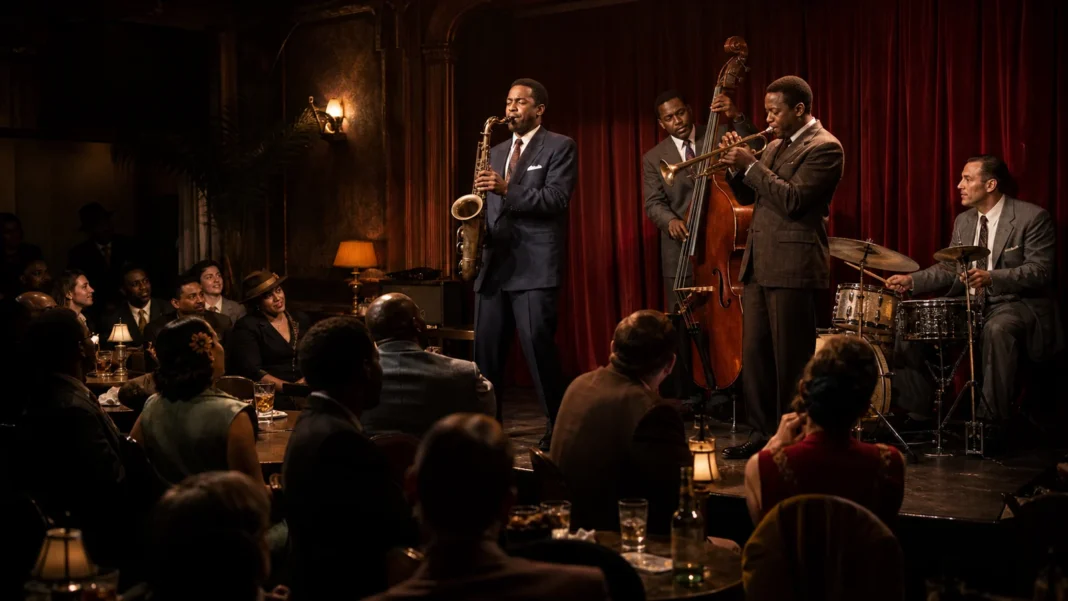

The quick answer: Jazz is an American musical art form shaped profoundly by African American experience and developed through blues, ragtime, spirituals, and other traditions. Its signature practice is improvisation: creating in the moment while listening closely to the ensemble.
New Orleans and many roots
Jazz emerged around the turn of the twentieth century, with New Orleans as a crucial center. African rhythmic traditions, blues expression, brass-band instrumentation, Caribbean influence, ragtime, work songs, and church music met in a port city alive with exchange. No single ingredient explains the sound; the innovation came through their encounter.
Improvisation is disciplined freedom
A jazz musician does not simply play anything. Improvisation works inside melody, harmony, rhythm, form, and the ideas offered by fellow players. A solo can be intensely individual while still serving the group. That balance helps explain why jazz feels so recognizably American: freedom becomes meaningful through skill and relationship.
The music travels
The Great Migration carried musicians and audiences to Chicago, Kansas City, New York, and beyond. Swing filled dance halls; bebop transformed small-group performance; later artists explored cool jazz, hard bop, free jazz, fusion, Latin jazz, and countless local scenes. Each generation treated the tradition as a foundation, not a fence.
A culture of attention
Jazz asks listeners to hear both inheritance and invention. The tune may be familiar, yet tonight’s performance will never happen in exactly the same way again. At America’s 250th, that is a worthy civic metaphor: know the form, listen across difference, make room for a distinct voice, and create something shared.
Quick facts
- New Orleans was a major early center of jazz.
- Improvisation is central, but it depends on musical structure and ensemble listening.
- The Great Migration helped jazz develop in cities across the country.
- Jazz has influenced popular music, film, dance, visual art, and global culture.
Questions readers ask
Did one person invent jazz?
No. Jazz developed collectively through many musicians and communities, although individual innovators played major roles in its evolution.
Why is jazz called an American art form?
It arose in the United States from a distinctive meeting of African American musical traditions and other cultural influences, then grew alongside American urban life.
Explore the sources
These primary and public-history resources are a good place to continue:
- Smithsonian National Museum of American History: What is Jazz?
- Library of Congress: Jazz research guide
250 Pulse tells the American story with context, confidence, and room for every neighbor.