
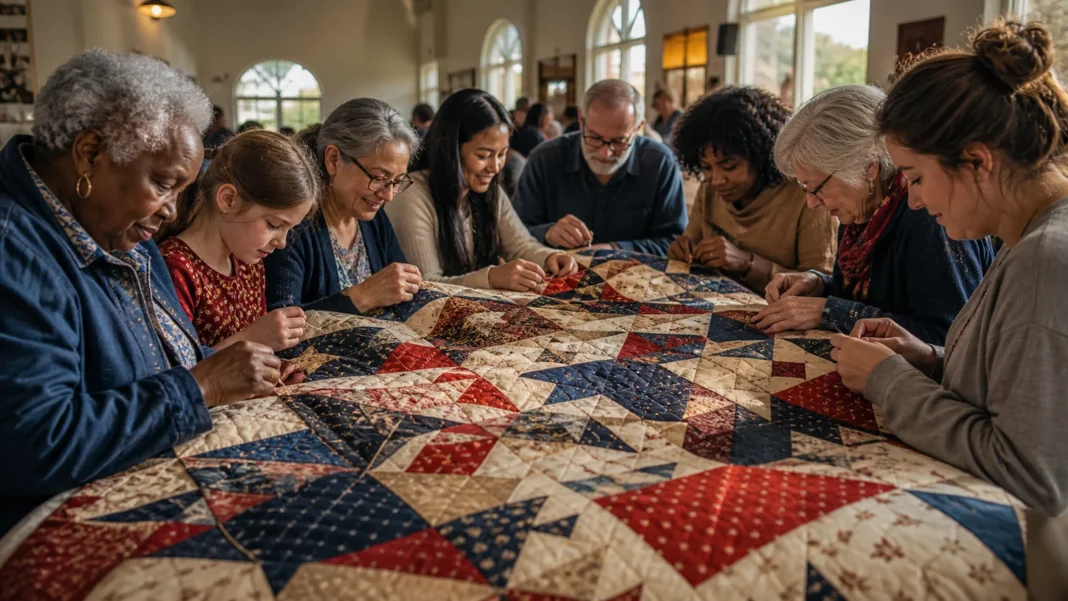

The quick answer: Quiltmaking in America joins practical craft with artistic expression and social memory. Quilts can warm a bed, mark a life event, preserve fabric, tell a community story, or reinterpret a pattern in a new voice.
Useful beauty
A quilt begins with function: layers of fabric joined to provide warmth. Yet utility never excluded beauty. Makers arranged color, geometry, stitching, applique, and embroidery into objects that could be ordinary household goods and careful artistic statements at the same time.
Patterns travel; people adapt
Named blocks and techniques pass among relatives, neighbors, books, shops, congregations, guilds, and cultural communities. A familiar pattern may look entirely different in another maker’s hands. Regional materials and personal circumstances shape the result, so continuity and originality can occupy the same blanket.
Quilts as records
Some quilts commemorate weddings, births, migrations, military service, loss, protest, or friendship. Others hold the material evidence of everyday life in reused clothing and scraps. Oral histories collected by the Library of Congress show that the maker’s account can be as revealing as the finished design.
A tradition still growing
Contemporary quilters use hand stitching, long-arm machines, digital design, inherited cloth, and experimental materials. At America’s 250th, the quilt remains a particularly generous national image: separate pieces retain their character, gain strength through connection, and become part of a larger pattern.
Quick facts
- Quilts may use piecing, applique, embroidery, or combinations of techniques.
- The Library of Congress preserves hundreds of quilt images and recorded interviews.
- Quilt contests have appeared at local and state fairs since the nineteenth century.
- Modern quiltmaking includes traditional, improvisational, pictorial, and experimental work.
Questions readers ask
Are American quilt patterns tied to only one culture?
No. American quiltmaking reflects many communities, regions, migrations, materials, and artistic lineages.
Why are oral histories important to quilts?
They preserve the maker’s purpose, relationships, techniques, and memories—context that may not be visible in the object alone.
Explore the sources
These primary and public-history resources are a good place to continue:
- Library of Congress: Quilts and Quiltmaking in America
- Library of Congress: The All-American Quilt Contest
250 Pulse tells the American story with context, confidence, and room for every neighbor.